 +91 8130134693
 info@sbaestheticsclinic.com


 +91 8130134693
 info@sbaestheticsclinic.com

From Safdarjung to Switzerland: The Training Behind Dr. Shilpi Bhadani’s Aesthetic Surgery Practice
 By Dr. Shilpi Bhadani
 November 24, 2026
In 2014, Dr. Shilpi Bhadani completed her MCh training in plastic surgery at VMMC and Safdarjung Hospital in New Delhi. Later that year, she travelled to Montreux, Switzerland, for an aesthetic-surgery fellowship at Laclinic.
She arrived with a foundation in reconstructive surgery and a particular question about the specialty she wanted to pursue. “I wanted to learn how good aesthetic decisions are made,” she later wrote of that period in an essay about her aesthetic-surgery fellowship.
The question has outlasted the fellowship. More than a decade later, she leads SB Aesthetics & Plastic Surgery Hospital in Gurugram, teaches younger surgeons and contributes to published work on surgical planning and reconstruction. Her career has taken her from learning how to make those decisions to explaining them to the surgeons who come to learn from her.
For someone considering plastic surgery in India from abroad, that background offers more than a list of qualifications. It raises a practical question: how does that training inform the assessment and planning of an individual operation?
The foundation in India
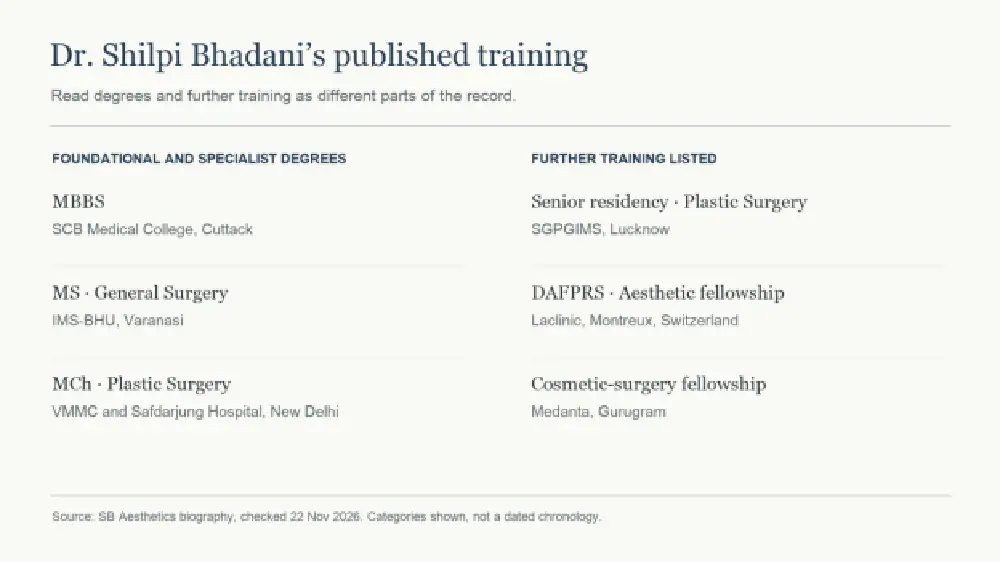
Surgery was familiar to Dr. Shilpi before medical school. Her hospital biography records that her father is a surgeon and that her early interest in aesthetic surgery preceded her formal medical education. The professional route that followed took her through several distinct settings: SCB Medical College in Cuttack, where she completed MBBS in 2004; the Institute of Medical Sciences at Banaras Hindu University, where she completed MS in General Surgery in 2010; and plastic-surgery residency at SGPGI in Lucknow before her MCh years at Safdarjung.
The names mark an education across medicine, general surgery and a specialty that includes both reconstruction and aesthetics. Her clinical work spans burns, maxillofacial trauma, flaps, grafts and breast reconstruction alongside surgery of the face and body.
That breadth puts a different emphasis on the familiar idea of changing appearance. Reconstruction begins with the condition of the tissues, what has been lost or altered, and what an operation is being asked to accomplish. Her professional work has continued to include those questions alongside elective aesthetic treatment.
The concerns of someone seeking reconstruction and those of someone considering an elective aesthetic change will differ. For a surgeon working across those areas, the starting point cannot be assumed from the procedure's name. Her subsequent work would continue to move between them.
For international patients comparing qualifications, SB Aesthetics' practical guide to choosing a plastic surgeon in India explains the country's specialist training pathway and what to verify before selecting a surgeon.
The question she took to Switzerland
The DAFPRS fellowship at Laclinic, Montreux, followed the completion of her specialist plastic-surgery training in 2014. Further cosmetic-surgery fellowship training at Medanta in Gurugram followed in 2015. She added Membership of the Royal College of Surgeons of Edinburgh to her qualifications in 2016.
General surgery, plastic and reconstructive surgery, and concentrated aesthetic training each occupy a different place in that education. The fellowships built on the specialist foundation. The Edinburgh membership was another qualification in a professional record that continued to develop after the MCh.
Her account of the Swiss period returns to assessment and proportion: understanding a person's expectations, evaluating risk and deciding how much change is appropriate. The destination was Montreux; the subject was the judgement around an elective operation.
For someone considering treatment today, this background provides context for a consultation. Qualifications are a starting point, not a decision about individual suitability. The next part of the story is how that accumulated training is brought into a conversation with an individual person.
Building a practice around the person seeking care
Her experience in Gurugram has included fellowship and consultant roles as well as her present work as Founder-Director and Chief Plastic Surgeon of SB Aesthetics. The practice spans surgical treatment, reconstruction, injectables and laser-based care, with a team supporting consultation, surgery, postoperative care and follow-up.
Patient education is central to how she describes that practice. Her stated philosophy begins with understanding the concern and recognising the thought that may have preceded the decision to seek help. An appointment is already partway through the patient's consideration of a change. These considerations are explored further in the hospital's article, Inside an Aesthetic Surgery Consultation: What Is Your Plastic Surgeon Really Assessing?
A person arriving at a consultation brings a reason for being there, expectations about what might change and practical limits on what treatment would mean in their life. For someone travelling from another country, those limits may include time away from home and the arrangements needed for recovery. The hospital's guide to preparing for plastic surgery in India addresses those practical considerations. Together, these concerns give the proposed treatment its context.
At SB Aesthetics, the published guide to what international patients can expect from a consultation describes how that conversation develops through medical history, previous procedures, examination and discussion of possible treatment. It distinguishes the preliminary assessment before travel from the in-person examination needed for final planning.
The difference is consequential. The consultation should help a patient understand the recommendation and which parts of it remain provisional. An initial discussion cannot be made more certain simply because flights and accommodation have already been arranged.
That breadth gives a consultation more than one possible direction. The assessment has to establish which approach, if any, fits the concern being discussed.
Patients can explore the practical side of that discussion in the hospital's guide to medical visa, consultation, surgery and recovery preparation. It connects the professional background to the facility, anaesthesia and follow-up arrangements that need to be understood before treatment.
Putting the planning on paper
Two publications coauthored by Dr. Shilpi bring that discussion into specific surgical problems.
The first concerns a planning problem in breast reduction. In the 2026 paper Precision by Numbers: A Numerical Mapping Method for Planning Breast Reduction in Asymmetric Breasts, she and her coauthors describe a numerical mapping method for breasts that differ in size and shape. The method aims to make preoperative planning more explicit and reproducible through defined reference measurements.
A reduction has to consider the form being created as well as the tissue being removed. The paper focuses attention on decisions made before the operation and on how a surgeon can describe those decisions clearly enough for others to examine them.
A different question appears in a 2025 case report on reconstruction after mastectomy. Dr. Shilpi and her coauthors describe sequential fat grafting in the setting of prior cancer treatment, scarring and volume loss. The report includes the patient's preference to avoid an implant and other reconstructive options involving additional scars.
That preference belongs within the clinical story. It shows why reconstructive planning can involve several possible routes and why understanding a person's priorities is part of assessing them. The paper concerns one case, and its authors call for larger prospective studies; it cannot establish a universal recommendation.
A related SB Aesthetics case study of staged fat grafting after mastectomy also explains the treatment-planning considerations in a patient-facing format.
The two papers address different problems, yet both give planning a substantial place in the account of surgery. Measurements make one proposed approach more explicit; a patient's preferences help shape the route discussed in the other. In each, there is a record of the reasoning that other surgeons can examine and discuss.
When the fellow becomes the mentor
Dr. Shilpi’s professional profile records eleven aesthetic-surgery fellows trained through her mentorship. The Indian Association of Aesthetic Plastic Surgeons independently lists her as a mentor at its recognised fellowship centre in Gurugram. Her teaching also extends to plastic-surgery education on the Marrow learning platform and faculty roles at professional meetings.
Teaching changes the demands made on professional experience. A surgeon may recognise why a plan is appropriate; explaining it to another surgeon requires bringing that reasoning into language. The choice has to become discussable.
In her essay about teaching aesthetic surgery, she puts assessment at the beginning: “learn to assess before you learn to operate.” Her description of the fellowship follows care from consultation and case selection through planning, the operation and follow-up. It is a view of training that includes the surrounding decisions as well as operative technique.
The distinction gives this part of her career its connection to the earlier one. A surgeon who sought additional aesthetic training now has younger surgeons coming to her practice to learn. The knowledge moves in another direction, carrying the obligation to explain why one approach was chosen and what another might have meant.
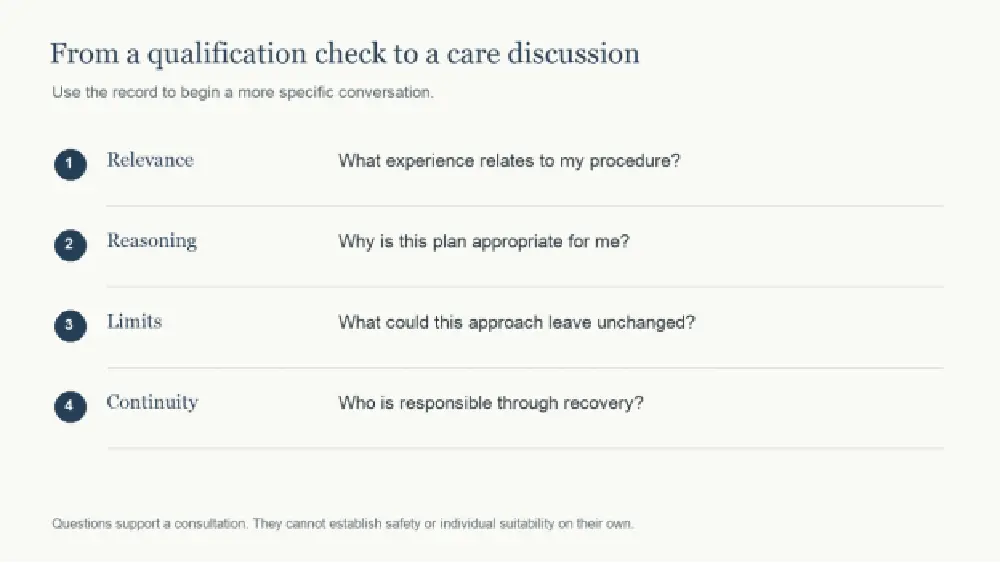
For a patient, the substance of that teaching role lies in the questions it makes visible: what has been assessed, why an approach is being considered and how its limitations can be explained.
A student, even while teaching
The professional record does not end with becoming a mentor. Her hospital biography puts the continuing commitment plainly: “As a surgeon, I am a student for life.”
The journey to Montreux in 2014 was an early expression of that outlook. Since then, her professional learning has continued through clinical practice, published research and teaching.
Her education began with learning the work of surgery. Today, it also includes making that work intelligible to the next surgeon and to the person considering an operation. The question she carried into her aesthetic fellowship now belongs on both sides of the consultation: what makes this a well-considered decision for this patient?
Medically reviewed by Dr. Shilpi Bhadani
MBBS, MS (General Surgery), MCh (Plastic Surgery), MRCS(Edin)
Haryana Medical Council Reg. No. HN36204
Founder-Director & Chief Plastic Surgeon, SB Aesthetics & Plastic Surgery Hospital, Gurugram
Medical information disclaimer: This article is for general patient education and does not replace an individual consultation, physical examination or medical advice. Treatment suitability, risks and recovery vary between patients.

Dr. Shilpi Bhadani
MBBS, MS - General Surgery, MCh - Plastic & Reconstructive Surgery,
DAFPRS Fellowship in Aesthetic Surgery


Request An Appointment
Recent Blog Posts
From Safdarjung to Switzerland: The Training Behind Dr. Shilpi Bhadani’s Aesthetic Surgery Practice
November 24, 2026
Bad Scars, Keloids and Scar Revision: What Can Actually Be Improved?
November 23, 2026
Am I Eligible for Weight-Loss Injections? BMI, Medical History and Other Factors Doctors Consider
November 17, 2026
How AI Is Changing Rhinoplasty Planning in 2026
November 16, 2026

SB Aesthetics is one of the renowned medical centers in Gurgaon offering world-class and most advanced plastic surgeries procedures under the guidance of Dr. Shilpi Bhadani.
Request An Appointment
Last reviewed: June 2026
Medically reviewed by Dr. Shilpi Bhadani.
Copyright © 2021-2026, SB Aesthetics. All Rights Reserved. Powered by DigiLantern


