 +91 8130134693
 info@sbaestheticsclinic.com


 +91 8130134693
 info@sbaestheticsclinic.com
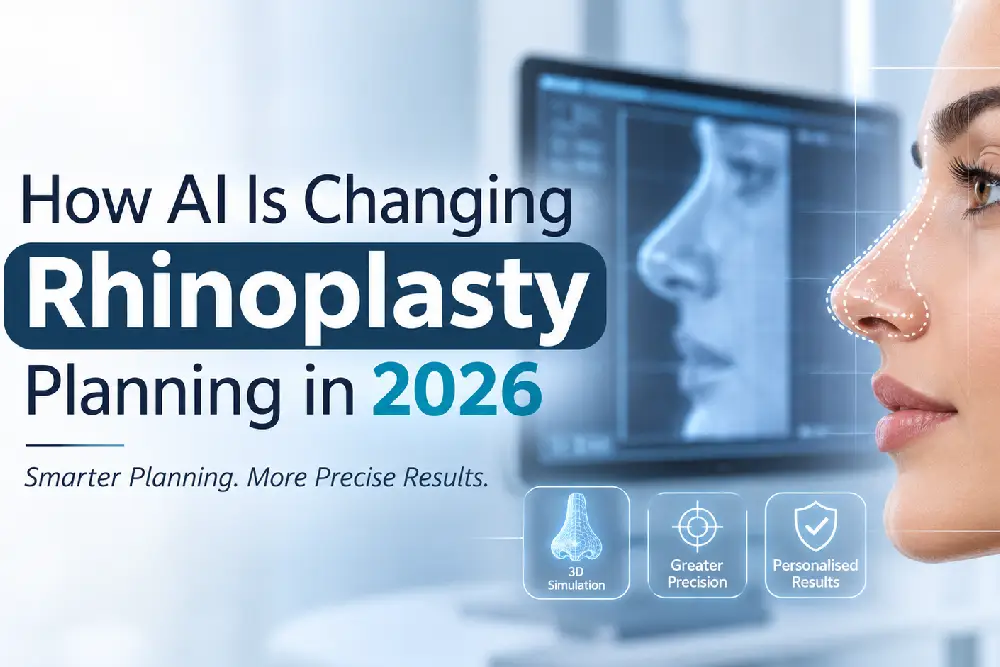
How AI Is Changing Rhinoplasty Planning in 2026
 By Dr. Shilpi Bhadani
 November 16, 2026
There was a time when planning a rhinoplasty meant looking at photographs, examining the nose from different angles, taking measurements and drawing a mental picture of what the final result could look like.
Then came computer imaging. Suddenly, patients could see a simulated version of their nose before surgery.
Now, in 2026, another shift is underway.
Artificial intelligence is beginning to change not just how the nose is visualised, but how surgeons analyse facial proportions, interpret images, compare anatomical patterns and think about surgical planning.
That does not mean a computer is deciding how someone's nose should look or performing rhinoplasty on its own. Rhinoplasty remains one of the most technically demanding procedures in plastic surgery, where millimetres can influence both appearance and breathing.
Instead, AI is emerging as another layer of information between the patient's anatomy and the surgeon's decision-making.
At SB Aesthetics and Plastic Surgery Hospital in Gurgaon, rhinoplasty is approached as an individualised procedure rather than a standard "nose reshaping" operation. Dr. Shilpi Bhadani, a leading plastic and reconstructive surgeon in Gurgaon, evaluates facial proportions, nasal structure, skin and the patient's aesthetic and functional concerns before developing a treatment plan.
The interesting question for 2026 is therefore not "Will AI replace the rhinoplasty surgeon?"
It is:
"How much better can a surgeon plan when human experience is supported by intelligent digital tools?"
Rhinoplasty Has Come a Long Way
Rhinoplasty itself is not new. The procedure has evolved dramatically from earlier techniques focused primarily on reducing prominent structures.
Modern rhinoplasty is much more nuanced. Surgeons increasingly consider the relationship between the nose and the rest of the face, structural support, preservation or restoration of nasal function, skin characteristics and the patient's individual proportions.
Technology has followed that evolution.
Two-dimensional photographs eventually gave way to computer morphing and then three-dimensional imaging. Today, surgeons can use 3D digital models to examine the nose from multiple angles and simulate potential changes.
Research has already shown why this matters. In one study of 172 patients seeking rhinoplasty, 95% of patients who experienced 3D simulation considered it an added value over 2D simulation. Among patients seeking revision rhinoplasty, 84% said computer simulation helped them understand the goals of surgery.
And the technology continues to develop.
Rhinoplasty Is Still a Very Popular Procedure
According to the International Society of Aesthetic Plastic Surgery (ISAPS) Global Survey 2024, more than 1.08 million rhinoplasty procedures were performed worldwide by plastic surgeons in 2024, placing rhinoplasty among the five most common surgical aesthetic procedures globally.
Interestingly, India accounted for approximately 67,760 rhinoplasty procedures in the same survey, making it the second-highest country by reported volume after Brazil.
That is a significant amount of surgical experience and potentially a significant amount of data from which future AI systems could learn.
So, What Exactly Can AI Do in Rhinoplasty Planning?
AI in rhinoplasty is not one single technology. It is a collection of tools that can potentially assist at different stages of planning.
1. It Can Analyse Facial Proportions
One of the most interesting possibilities is automated facial analysis.
AI systems can be trained to identify anatomical landmarks and analyse relationships between features such as:
- Nasal width and height
- Nasal projection
- Nasolabial angle
- Tip position
- Facial symmetry
- Relationship between the nose, lips, chin and other facial structures
This can help create a more structured assessment of facial proportions.
But there is an important distinction: AI can measure relationships; it cannot decide what is aesthetically right for every individual.
Beauty is not a mathematical equation.
2. It Can Make 3D Planning More Sophisticated
Traditional 3D simulation allows the surgeon and patient to visualise possible changes.
AI could make these systems more intelligent by analysing the patient's actual anatomy and generating simulations based on anatomical parameters rather than simply manipulating an image.
Recent research continues to support the usefulness of digital planning. A 2025 study of 38 rhinoplasty patients found that greater accuracy of preoperative 3D simulation was significantly associated with higher postoperative patient satisfaction.
That does not mean a simulation guarantees the surgical result. It means better visual alignment between planning and outcome may contribute to better expectation management.
3. AI May Help Compare More Surgical Possibilities
Imagine being able to digitally compare several potential approaches rather than looking at only one proposed outcome.
An AI-assisted system could potentially analyse a patient's anatomy and generate different planning scenarios. For example, changes in dorsal contour, tip projection or nasal width, while allowing the surgeon to assess which options are anatomically appropriate.
The surgeon remains responsible for deciding which option is safe, realistic and suitable.
This distinction is crucial.
AI can generate possibilities. The surgeon has to determine which possibilities belong in the operating room.
4. It Could Help With Patient-Specific Planning
No two noses are identical.
Skin thickness, cartilage strength, previous trauma, septal deviation, asymmetry and previous surgery can all affect planning.
Future AI systems may become increasingly capable of combining multiple forms of information including photographs, 3D surface scans, CT imaging where medically indicated and clinical measurements, to create a more comprehensive digital representation of the patient's anatomy.
Could AI Make Rhinoplasty More Personalised?
Potentially, yes.
Historically, aesthetic ideals have sometimes encouraged standardised ideas of the "perfect nose." AI could actually move rhinoplasty in the opposite direction if used appropriately.
Instead of asking:
"What nose looks best?"
the future may increasingly ask:
"What nasal proportions are most harmonious with this particular face?"
That could mean more emphasis on facial harmony, ethnic and individual anatomy, natural-looking outcomes and preservation of identity.
For a procedure as visible as rhinoplasty, that is an important shift.
Will AI Replace Rhinoplasty Surgeon?
This is perhaps the most important point.
Rhinoplasty involves more than image analysis.
A surgeon has to physically examine the nose, understand cartilage and bone, assess breathing, interpret asymmetries, anticipate tissue behaviour and make intraoperative decisions when anatomy does not behave exactly as expected.
AI cannot palpate cartilage. It cannot assess tissue quality with a surgeon's hands. And it cannot take responsibility for a surgical decision.
The most realistic future is therefore not AI versus surgeon. It is AI + surgeon.
The technology provides additional information. The surgeon provides clinical judgement, technical skill, experience and accountability.
What Could Rhinoplasty Look Like Five Years From Now?
If current developments continue, rhinoplasty planning could become considerably more data-driven.
A future consultation could potentially involve:
Facial scan → AI-assisted anatomical analysis → 3D simulation → multiple surgical scenarios → surgeon-led refinement → personalised surgical plan → postoperative comparison.
AI could also eventually help surgeons analyse their own outcomes over hundreds or thousands of cases, identifying patterns that are difficult to detect manually.
At SB Aesthetics and Plastic Surgery Hospital, Dr. Shilpi Bhadani evaluates rhinoplasty candidates based on their individual facial proportions, nasal anatomy, aesthetic expectations and functional concerns.
Digital imaging and simulation can support this process by helping patients understand potential changes and communicate what they want. But the final surgical plan must be based on clinical examination and what is realistically achievable for that particular nose.
That balance between technology and surgical judgement is likely to become increasingly important as AI develops.
The Future of Rhinoplasty May Be Smarter; Not Less Human
Rhinoplasty has already travelled from photographs and manual measurements to computer morphing, 3D imaging and increasingly sophisticated digital planning.
AI is the next chapter.
It may help surgeons see patterns more clearly, analyse anatomy faster, personalise simulations and eventually learn from enormous collections of surgical outcomes.
But the future of rhinoplasty is unlikely to be a machine designing everyone's "perfect nose."
It may be something much more interesting:
a surgeon who understands your face, supported by technology that understands your data.
And perhaps that is where AI can make the biggest difference—not by making rhinoplasty less human, but by giving surgeons better information to make deeply human decisions.
Frequently Asked Questions
Can AI predict exactly how my nose will look after rhinoplasty?
No. AI and 3D simulation can create a visual estimate of a possible outcome, but they cannot guarantee the final result. Healing, swelling, scar formation and individual tissue behaviour can affect the postoperative appearance.
Is AI currently used instead of a surgeon for rhinoplasty planning?
No. AI is an emerging supportive technology. Clinical examination, surgical judgement and the surgeon's understanding of nasal anatomy remain essential.
Does AI make rhinoplasty safer?
AI may improve information gathering, planning and visualisation, but it should not be described as independently making rhinoplasty safer. Surgical safety still depends on appropriate patient selection, medical assessment, surgical technique and postoperative care.
Can AI tell me which nose will look best on my face?
AI can analyse facial proportions and generate simulations, but "best" is not purely mathematical. A surgeon must consider anatomy, facial harmony, functional requirements and the patient's own preferences.
Will AI make rhinoplasty completely personalised in the future?
It may contribute significantly to greater personalisation. Future systems could potentially combine facial scans, anatomical measurements and postoperative data to support patient-specific planning. However, this remains an evolving area of research.
Does SB Aesthetics use technology for rhinoplasty planning?
Technology can support the consultation and visualisation process, but rhinoplasty planning at SB Aesthetics is ultimately based on individual assessment by Dr. Shilpi Bhadani, including facial proportions, nasal anatomy, aesthetic goals and functional considerations.

Dr. Shilpi Bhadani
MBBS, MS - General Surgery, MCh - Plastic & Reconstructive Surgery,
DAFPRS Fellowship in Aesthetic Surgery


Request An Appointment
Recent Blog Posts
Am I Eligible for Weight-Loss Injections? BMI, Medical History and Other Factors Doctors Consider
November 17, 2026
How AI Is Changing Rhinoplasty Planning in 2026
November 16, 2026
Medical Weight Loss in Gurgaon: From Your First Assessment to Long-Term Weight Management
November 10, 2026
Grade 1, 2 and 3 Gynecomastia: Which Cases Need Surgery?
November 9, 2026
360° Liposuction: What Is It and Who Is a Good Candidate?
November 6, 2026

SB Aesthetics is one of the renowned medical centers in Gurgaon offering world-class and most advanced plastic surgeries procedures under the guidance of Dr. Shilpi Bhadani.
Request An Appointment
Last reviewed: June 2026
Medically reviewed by Dr. Shilpi Bhadani.
Copyright © 2021-2026, SB Aesthetics. All Rights Reserved. Powered by DigiLantern


