 +91 8130134693
 info@sbaestheticsclinic.com


 +91 8130134693
 info@sbaestheticsclinic.com
Grade 1, 2 and 3 Gynecomastia: Which Cases Need Surgery?
 By Dr. Shilpi Bhadani
 November 9, 2026
Gynecomastia can range from a small, firm swelling beneath the nipple to significant enlargement of the male chest with excess skin and sagging. Because the extent and appearance can vary considerably, gynecomastia is commonly classified into different grades.
But an important point is often misunderstood: the grade of gynecomastia does not automatically determine whether surgery is required. The decision depends on factors such as how long the condition has been present, whether an underlying cause has been identified, the amount of glandular tissue, excess fat or skin, and how significantly it affects the individual.
At SB Aesthetics and Plastic Surgery Hospital in Gurgaon, Dr. Shilpi Bhadani, a leading, popular plastic and reconstructive surgeon, evaluates these factors before recommending treatment. The aim is not simply to remove breast tissue, but to create a balanced, natural-looking male chest while addressing the specific cause and severity of enlargement.
What Is Gynecomastia?
Gynecomastia is the benign enlargement of male breast tissue, usually involving glandular tissue beneath the nipple and areola. It may occur on one or both sides and can develop during puberty or adulthood.
It is important to distinguish true gynecomastia from pseudogynecomastia, where chest enlargement is primarily caused by excess fat. Some men have a combination of both glandular tissue and fat. This distinction matters because weight loss can improve a fatty chest but may not eliminate established glandular tissue.
Understanding the Grades of Gynecomastia
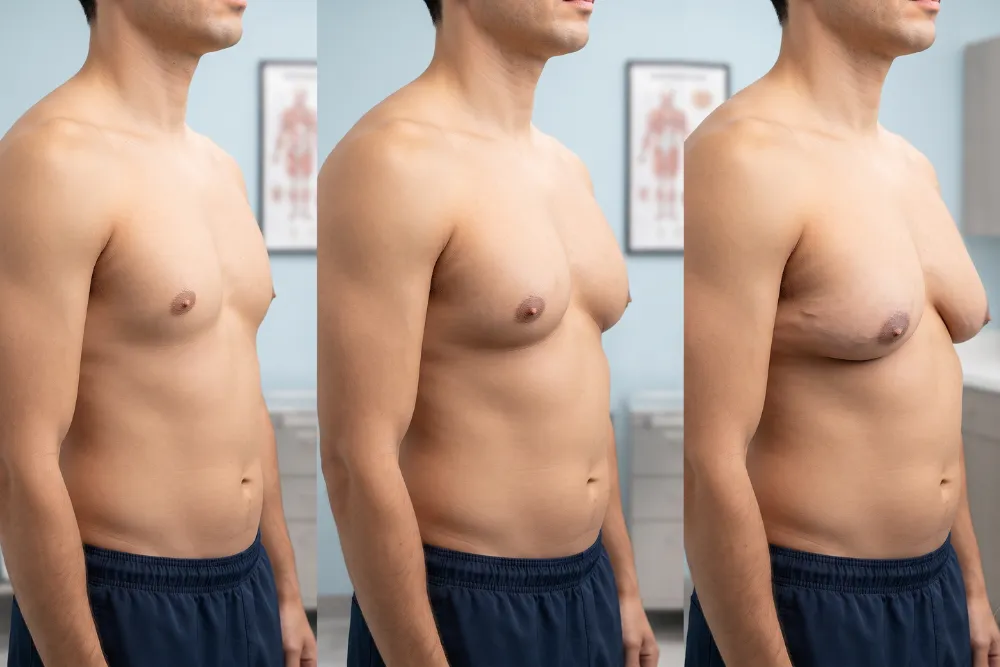
The Simon classification is one of the commonly used systems for describing gynecomastia. It actually divides the condition into four categories: Grade I, Grade IIa, Grade IIb and Grade III.
| Grade | Main characteristics | Is surgery usually needed? |
| Grade I | Small enlargement, no significant excess skin | Not necessarily |
| Grade IIa | Moderate enlargement without excess skin | May be considered |
| Grade IIb | Moderate enlargement with some excess skin | More likely |
| Grade III | Significant enlargement with excess skin and sagging | Often considered |
The distinction between Grade IIa and IIb is important because skin excess can influence the surgical approach.
Grade 1 Gynecomastia
Grade I is the mildest form. There is usually a small amount of glandular tissue beneath the nipple, but no significant excess skin. The enlargement may be subtle and, in some cases, tender.
Does Grade 1 need surgery?
Not necessarily.
If gynecomastia has developed recently, particularly during puberty, observation may be appropriate because some cases resolve naturally. The underlying cause should also be assessed before considering surgery.
Surgery may become an option when the enlargement is persistent, causes significant embarrassment or psychological distress, or does not improve after an underlying cause has been addressed.
When surgery is appropriate, treatment may involve removal of glandular tissue, liposuction if excess fat is also present, or a combination of both.
Grade 2 Gynecomastia
Grade II represents moderate enlargement and is divided into two subcategories.
Grade IIa
There is moderate breast enlargement without significant excess skin. The skin generally has reasonable elasticity, making it possible to achieve a flatter chest after removing the excess tissue.
Grade IIb
There is moderate enlargement accompanied by some skin excess or laxity. This can make correction more complex because simply removing glandular tissue or fat may leave loose skin.
Does Grade 2 need surgery?
It depends on the individual case.
Persistent Grade II gynecomastia is more likely to be considered for surgery when the enlargement is stable, does not regress after addressing an underlying cause, or causes significant physical or psychological concerns.
Grade IIa may sometimes be treated with glandular excision, liposuction or both. Grade IIb may require additional attention to the skin envelope depending on the amount of laxity. Surgical literature supports tailoring the procedure according to the tissue composition and degree of skin excess.
Grade 3 Gynecomastia
Grade III is the most advanced category in the Simon classification. It involves marked breast enlargement with excess skin and noticeable sagging, sometimes creating a breast-like contour.
At this stage, the problem is not limited to glandular tissue or fat. The surgeon must also consider the amount of loose skin and the position of the nipple-areola complex.
Does Grade 3 need surgery?
Persistent Grade III gynecomastia is the grade most likely to require surgical correction.
Treatment may involve:
- Liposuction to remove excess fatty tissue
- Excision of dense glandular tissue
- Removal of excess skin
- Repositioning of the nipple-areola complex in selected advanced cases
The exact technique depends on the degree of enlargement, skin redundancy, tissue composition and chest anatomy. Grade III cases therefore require more comprehensive surgical planning than mild cases.
Which Grades of Gynecomastia Actually Need Surgery?
The answer cannot be based on grade alone.
Grade I does not automatically require surgery. Grade II may require surgery depending on persistence and symptoms. Grade III is the most likely to require surgery when significant skin excess and sagging are present.
Surgery is generally considered when:
- Gynecomastia has been present for a prolonged period without regression
- An underlying medical or hormonal cause has been addressed but enlargement persists
- Appropriate medical management has not resolved the condition
- There is persistent pain or tenderness
- The chest causes significant psychological or social distress
- There is considerable skin excess or sagging
- The patient is medically fit for surgery and has realistic expectations
The 2026 SIAMS clinical practice guidelines recommend surgery particularly for long-standing fibrotic gynecomastia that shows no tendency to regress and has not responded to appropriate medical treatment, especially when psychological distress is significant.
When Surgery Need Not Be the First Step
A gynecomastia diagnosis does not automatically mean that cosmetic surgery should be performed.
The first step is understanding why the enlargement has occurred. Possible causes include normal hormonal changes during puberty, certain medications, hormonal disorders, medical conditions and use of anabolic or other exogenous substances.
A detailed medical history and physical examination are important, with hormonal tests or imaging performed when clinically indicated. For recent-onset physiological gynecomastia, observation may be recommended before considering surgery.
This is particularly relevant for adolescents, where gynecomastia may resolve naturally.
How Is Gynecomastia Surgery Planned?
There is no single surgical technique suitable for every grade.
Depending on the individual anatomy, treatment may involve liposuction, glandular tissue excision or a combination of both. When there is significant skin redundancy, additional skin-reduction procedures may be necessary.
The surgeon also considers the position of the nipple and areola, skin elasticity, chest proportions and the amount of fatty versus glandular tissue. Two men with the same grade can therefore receive different treatment plans.
Why Choose SB Aesthetics for Gynecomastia Treatment in Gurugram?
At SB Aesthetics and Plastic Surgery Hospital in Gurgaon, gynecomastia correction is planned according to the individual's chest anatomy rather than using the same procedure for every patient.
Dr. Shilpi Bhadani's expertise in plastic and reconstructive surgery allows the assessment to consider glandular tissue, fat, skin quality, nipple position and overall chest proportions. Depending on the findings, the recommended approach may range from observation to surgical correction.
Frequently Asked Questions
Can gynecomastia affect only one side of the chest?
Yes. Gynecomastia can be unilateral or bilateral, and the degree of enlargement may differ between the two sides.
Can exercise get rid of gynecomastia?
Exercise can reduce overall body fat and improve the appearance of a fatty chest. However, established glandular tissue generally does not disappear through exercise alone.
Is Grade III gynecomastia always treated with surgery?
Not automatically. However, persistent Grade III cases with significant excess skin and sagging are much more likely to require surgical correction because lifestyle measures alone cannot remove substantial glandular tissue or redundant skin.
Is gynecomastia caused only by low testosterone?
No. Gynecomastia can have several causes, including hormonal imbalance, medications, medical conditions and physiological changes. Low testosterone is only one possible contributing factor.
Can gynecomastia return after surgery?
Recurrence is possible, particularly if an underlying cause remains untreated or significant hormonal or weight-related changes occur. Identifying and addressing contributing factors is therefore an important part of treatment planning.
Does a larger chest always mean a higher gynecomastia grade?
No. The classification considers not only the amount of enlargement but also factors such as skin redundancy. This is why clinical examination is important for determining the grade and appropriate treatment.

Dr. Shilpi Bhadani
MBBS, MS - General Surgery, MCh - Plastic & Reconstructive Surgery,
DAFPRS Fellowship in Aesthetic Surgery


Request An Appointment
Recent Blog Posts
Medical Weight Loss in Gurgaon: From Your First Assessment to Long-Term Weight Management
November 10, 2026
Grade 1, 2 and 3 Gynecomastia: Which Cases Need Surgery?
November 9, 2026
360° Liposuction: What Is It and Who Is a Good Candidate?
November 6, 2026

SB Aesthetics is one of the renowned medical centers in Gurgaon offering world-class and most advanced plastic surgeries procedures under the guidance of Dr. Shilpi Bhadani.
Request An Appointment
Last reviewed: June 2026
Medically reviewed by Dr. Shilpi Bhadani.
Copyright © 2021-2026, SB Aesthetics. All Rights Reserved. Powered by DigiLantern


