 +91 8130134693
 info@sbaestheticsclinic.com


 +91 8130134693
 info@sbaestheticsclinic.com

Is Cosmetic Surgery in India Safe? What to Check Beyond Your Surgeon’s Credentials
 By Dr. Shilpi Bhadani
 November 4, 2026
The safety of cosmetic surgery in India depends on the patient, the procedure, the surgical team and the setting. No country or qualification makes an operation risk-free. Before deciding, look at how the proposed care fits your health and how it will continue from assessment through recovery.
A surgeon’s profile is a sensible place to begin. It is also a narrow view of a larger undertaking. Before the operation, your medical history must inform the plan. During it, anaesthesia and monitoring need appropriate people and resources. Afterwards, you need to know who will assess your recovery and what will happen if you need more care.
For Indian patients and people travelling from abroad, this wider view makes the safety question more useful. It turns a general search for reassurance into a conversation about a particular operation, in a particular place, for you.
For someone travelling to India, there is another consideration: you may be making decisions about a surgical facility, recovery arrangements and follow-up care from thousands of kilometres away. Some of those details should be clarified before travel, even though the final clinical recommendation may change after an in-person assessment.
Start with the surgeon, then follow the proposed care
Verify the surgeon’s specialist qualifications and registration, and discuss their experience with the procedure you are considering. Our guide to choosing a plastic surgeon in India explains that first stage in more detail.
Then widen the conversation. The Association of Plastic Surgeons of India’s patient-safety guidance includes questions about where the procedure will take place, the help needed during recovery and how complications are handled. These questions belong alongside the surgeon’s qualifications.
You are trying to understand the plan. You are not expected to inspect an operating theatre, judge equipment or certify a hospital’s safety yourself. If an answer uses unfamiliar terminology, ask what it means for your procedure.
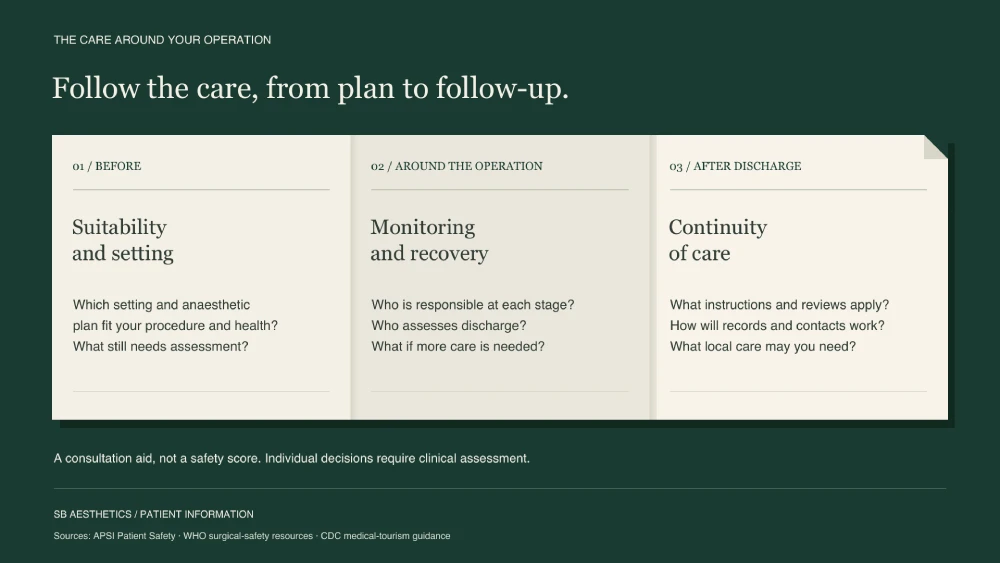
Identify the exact facility where the operation is proposed
Establish the facility’s full name and address, even if your consultation has already taken place. Ask whether the proposed operating location is the same as the consultation location. This avoids assuming that everything described on a website applies to every site associated with a clinician or organisation.
The next question is why that setting is appropriate for your operation and health. A small procedure under local anaesthesia and a longer operation under general anaesthesia raise different planning questions. A useful explanation should connect the proposed technique, staff, monitoring and recovery arrangements to your case.
Ask what support is available at that location if your recovery needs more attention than expected. If the team describes access to another hospital, clarify what can be managed onsite and what would require a transfer. Knowing how care is organised is more useful than simply knowing what equipment a facility has.
These questions do not require every operation to take place in the largest possible hospital. They require a clinical explanation for the setting being recommended, including its limits.
Understand the anaesthesia plan and who is responsible
Anaesthesia deserves its own conversation. Ask what technique is proposed, why it suits the procedure and your health, and who will be responsible for providing it and monitoring you.
The words “local”, “sedation” and “general” describe different approaches. They do not, on their own, give you a personal risk assessment. The Australian and New Zealand College of Anaesthetists’ cosmetic-surgery guidance explains why the anaesthetist, the practitioner and the setting need to be considered together. Ask how those responsibilities are arranged for the proposed care in India.
For a plan involving an anaesthesiologist, ask when you will have the opportunity to discuss it with them. Bring questions about previous anaesthesia problems, relevant health conditions and anything that worries you about the proposed technique. Ask which concerns need assessment before the day of surgery.
Give the clinical team a complete, current list of what you take. Include prescribed medicines, medicines obtained online, weight-management treatments, hormonal medicines, supplements and herbal products. The Royal College of Anaesthetists’ patient information explains why this information matters to planning anaesthesia. Do not stop or change a medicine because of a general article; get instructions from the clinicians responsible for your care.
Ask for fasting and medication instructions in a form you can refer to later. If two instructions appear to conflict, contact the team for clarification. Guessing is an avoidable burden to place on yourself before an operation.
Make room for the assessment to change the plan
Choosing a surgeon and finding an available date do not establish that surgery is appropriate. The assessment needs to consider your health, the change you want and what the procedure can reasonably achieve.
Be candid about previous surgery, complications, allergies, smoking or vaping, and any difficulty with anaesthesia. Bring relevant records rather than relying on a brief summary from memory. Ask which additional information or tests are needed for your proposed operation; there is no single test list in this guide that can clear every patient.
Consent should leave room for a real choice. Discuss the likely scars, important risks, recovery demands and limits of the result, as well as alternatives that may include postponement or no surgery. Ask what could lead the surgeon to recommend a smaller or staged plan. A staged approach also has its own trade-offs; it is not an automatic safety guarantee.
For overseas patients, a remote discussion can help organise questions and records. It should leave room for an in-person examination and further assessment to change the recommendation. Ask what remains provisional before making commitments that are difficult to alter.
For someone travelling from abroad, it may be tempting to organise everything around an available surgical date. But the examination may reveal reasons to change or postpone the operation. Leave room for that possibility before committing to arrangements that are difficult to alter.
Make the risk discussion specific to the operation
The word “complication” can be too broad to help you decide. Ask which problems are relevant to the proposed procedure, how your health affects the assessment and how those problems would be recognised and managed.
The discussion may include bleeding, infection, wound-healing problems, blood clots and anaesthesia-related complications, where relevant. Ask about scars and the possibility that the appearance may differ from what you hope to achieve. These examples are not a complete list, and their likelihood is not the same for every operation or patient. The NHS information on facelift risks offers one procedure-specific example of how general surgical risks and particular concerns can be discussed separately; it does not provide an Indian complication rate.
If a number is quoted, ask what it measures. Does it describe this procedure, a particular group of patients or a different operation? Does it refer to an early complication or a later need for further treatment? A percentage is useful only when its meaning and relevance are clear.
You do not need to remember a catalogue of everything that could happen. You need enough understanding to weigh the proposed benefit against the important risks and recovery demands, including the option of deciding that surgery is not right for you.
Look for coordination around the operation
Several people may contribute to your care. Ask how important information moves between them: the operation agreed, relevant allergies, the anaesthetic plan and the instructions for recovery.
The World Health Organization’s surgical-safety checklist illustrates this emphasis on communication. It uses checks around three points: before anaesthesia, before the incision and before the patient leaves the operating room. Its purpose includes making important information explicit within the team.
You can ask whether the facility uses a structured surgical-safety process and how it applies to your care. You do not need to administer the team’s checklist. The existence of a form also cannot establish how consistently a process is used.
The same principle applies to infection prevention. Ask the treating team to explain the measures relevant to your procedure and the wound-care instructions you will receive. A patient cannot judge sterilisation quality from a room photograph. What you can seek is an understandable explanation of the facility’s process and your part in aftercare.
Ask what happens if more care is needed
An emergency plan is worth discussing before an elective operation. Ask who would assess an unexpected problem, what the team can manage at the facility and how they would arrange additional care if it were needed.
If transfer is part of the answer, ask how it would be initiated and what arrangements apply. “There is a hospital nearby” leaves practical questions open: who makes the clinical decision, who organises transport and how information reaches the receiving team?
The International Society of Aesthetic Plastic Surgery’s safety guidance includes the surgical setting, trained personnel and emergency procedures in its framework. Asking about escalation is a way to understand those arrangements; it is not a prediction that a complication will occur.
Costs deserve the same clarity. Request a written explanation of the proposed package and its exclusions. Ask how additional observation, unplanned treatment or care at another facility would be charged, and check any insurance cover directly with the insurer. An initial quotation cannot answer every later financial question unless its terms explain them.
Know what discharge will mean for you
Leaving the facility is one point in recovery. Ask who will assess whether you are ready, what instructions you will receive and what help you should arrange afterwards.
There are several different questions here. Can you leave the facility? Can you manage where you are staying? Can you return to work, exercise or travel? Each concerns a different demand on recovery. Ask for advice specific to your operation and progress rather than treating a single number of days as the answer to all of them.
Before discharge, make sure you understand the plan for medicines, wound care, review appointments and concerns that need assessment. Ask the team to distinguish expected changes from warning signs for your procedure. Find out which contact route is for routine questions, what to do outside normal hours and where to seek urgent care.
Serious symptoms such as sudden difficulty breathing, chest pain or heavy bleeding require urgent medical assessment. The treating team should explain the warning signs relevant to your operation and where to seek help if they occur.
A messaging number is useful only if you understand its purpose and limits. If you believe you are having a medical emergency, seek urgent local care; do not wait for a remote reply.
For someone staying in a hotel or with relatives, discuss practical help as well as clinical reviews. Ask what assistance may be needed and whether a responsible adult should stay with you. A room reservation can provide somewhere to sleep. It does not establish that the recovery arrangements are suitable.
For international patients, plan the handover home
The arrangements need to extend beyond the return journey. Before travelling, discuss follow-up with the treating team and the clinician who may care for you at home. Clarify what can be reviewed remotely and what would need an examination.
The CDC Yellow Book’s medical-tourism guidance recommends obtaining medical records for subsequent care. Ask how you will receive the operation and discharge summaries, medication information and other relevant records in a language your next clinician can use.
Air travel and surgery can both contribute to blood-clot risk. A return ticket therefore cannot establish readiness to fly. Discuss your procedure, recovery and journey with your clinical team, and check the airline’s requirements separately. This guide does not offer a universal safe-to-fly day.
Our international-patient preparation guide covers the broader travel preparation. The safety question here is continuity: how information and responsibility will carry over when you leave India.
Take these five questions to the consultation
Use these prompts to organise the discussion after checking the surgeon’s credentials. They are a conversation aid, not a safety score.
- Where exactly will my operation take place, and why is that setting appropriate for me? Clarify the facility, relevant status claims and the resources proposed for your case.
- What is my anaesthesia plan, and who is responsible for it? Ask when you can discuss your health, medicines and individual risks with the appropriate clinician.
- Who will monitor my recovery and decide when I can leave? Understand the immediate recovery arrangements and the help needed afterwards.
- How would an unexpected problem be assessed and managed? Clarify onsite support, escalation and any transfer arrangements that apply.
- How will follow-up work once I am away from the facility? Ask about reviews, records, contact routes, urgent care and, if relevant, the handover home.
If a consequential answer remains unclear, seek clarification before committing. A second opinion may help when you are uncertain about the proposed procedure or arrangements. You can also decide to wait or not proceed.
Safety cannot be reduced to a profile, a building or a country. The decision becomes clearer when you can follow the care being proposed: who will assess you, where the operation will happen, how recovery will be supported and what happens next if the plan needs to change.
Medically reviewed by Dr. Shilpi Bhadani
MBBS, MS (General Surgery), MCh (Plastic Surgery), MRCS(Edin)
Haryana Medical Council Reg. No. HN36204
Founder-Director & Chief Plastic Surgeon, SB Aesthetics & Plastic Surgery Hospital, Gurugram
For international-patient enquiries, WhatsApp: +91 81301 34693.
Medical information disclaimer: This article is for general patient education and does not replace an individual consultation, physical examination or medical advice. Treatment suitability, risks and recovery vary between patients.

Dr. Shilpi Bhadani
MBBS, MS - General Surgery, MCh - Plastic & Reconstructive Surgery,
DAFPRS Fellowship in Aesthetic Surgery


Request An Appointment
Recent Blog Posts
What to Expect from a Consultation at SB Aesthetics: A Guide for International Patients
October 26, 2026
How to Choose a Plastic Surgeon in India
October 23, 2026

SB Aesthetics is one of the renowned medical centers in Gurgaon offering world-class and most advanced plastic surgeries procedures under the guidance of Dr. Shilpi Bhadani.
Request An Appointment
Last reviewed: June 2026
Medically reviewed by Dr. Shilpi Bhadani.
Copyright © 2021-2026, SB Aesthetics. All Rights Reserved. Powered by DigiLantern


