 +91 8130134693
 info@sbaestheticsclinic.com


 +91 8130134693
 info@sbaestheticsclinic.com

Am I Eligible for Weight-Loss Injections? BMI, Medical History and Other Factors Doctors Consider
 By Dr. Shilpi Bhadani
 November 17, 2026
Weight-loss injections may be an option for some adults, but a body mass index (BMI) number alone cannot establish whether one is appropriate for you. A qualified prescribing clinician needs to consider the particular medicine's approved use, your health history, other treatments and the benefits and risks of starting it.
You can calculate BMI in a few seconds. The information needed for a prescription takes longer to understand.
That distinction matters when you encounter different numbers online. One source may describe obesity at a lower BMI in Indian adults, while a medicine's information gives a higher starting threshold for weight management. These statements can be doing different jobs. A health-risk classification, a clinical recommendation and a product's approved indication are not interchangeable.
This guide explains those differences and the conversation that should follow them. For the wider pathway, from your first assessment to follow-up and maintenance, read our guide to medical weight-loss assessment and long-term management. It is adult patient education, rather than a test that can tell you whether to start treatment.
Why BMI matters and why it cannot answer everything
BMI expresses weight in relation to height. It helps organise an assessment, but it does not describe the whole person: where body fat is distributed, which health problems are present, what medicines are already being used or what a proposed treatment would require.
The Endocrine Society of India's clinical guidance considers measures beyond BMI and the health effects associated with excess body fat. For an Indian reader, this is particularly relevant because abdominal fat and cardiometabolic risk deserve attention even when the BMI does not look especially high. Cardiometabolic risk refers to concerns involving metabolism and cardiovascular health, including blood glucose, blood pressure and blood fats.
The useful question is therefore not simply, “What is my BMI?” It is, “What does this measurement mean alongside the rest of my assessment?”
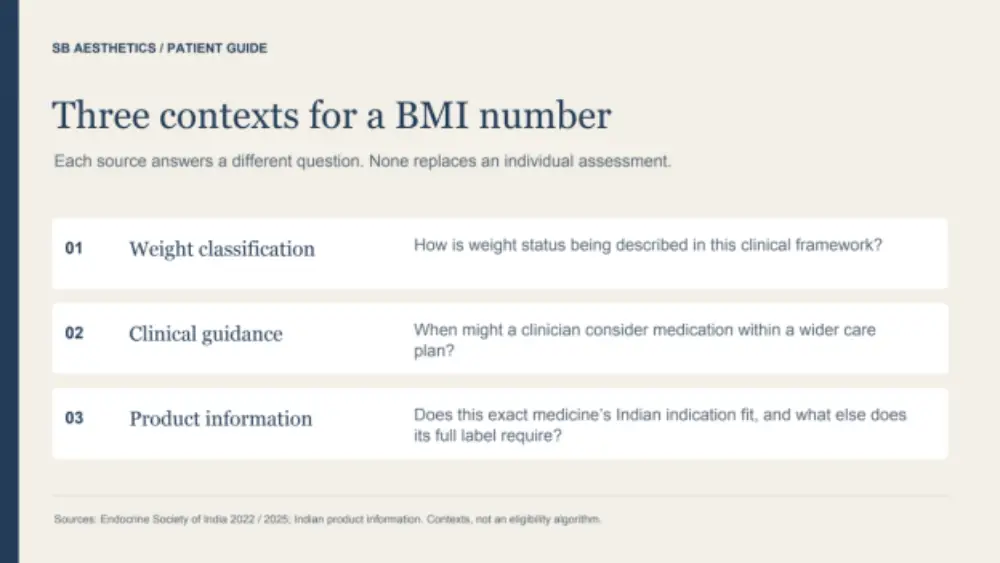
Why different sources give different BMI thresholds
Before comparing two numbers, check what each source is describing. The examples below show why a single online cut-off can mislead.
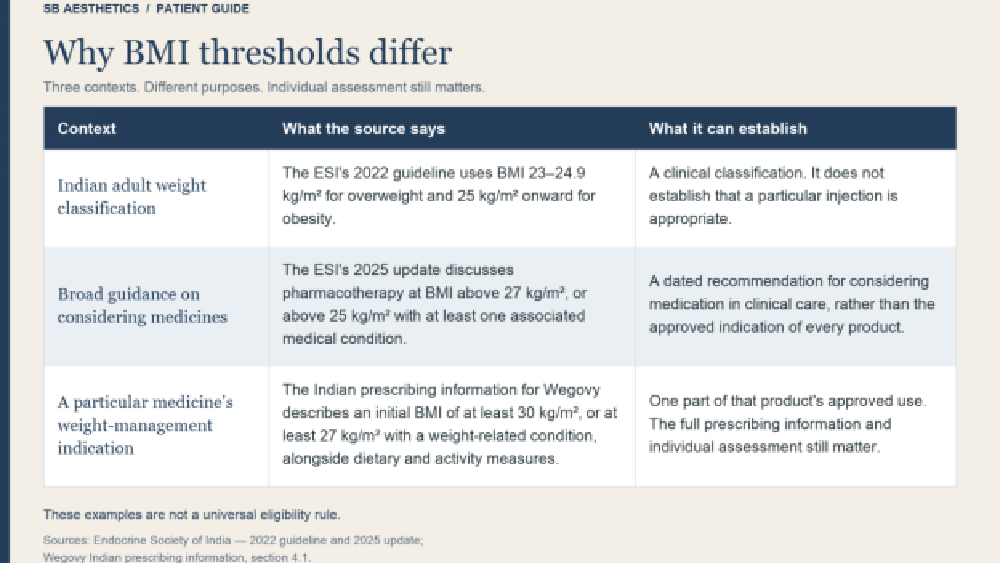
Indian guidance continues to develop, and a prescriber must check the current Indian information for the exact medicine and formulation being considered.
For example, being within a guideline's obesity category does not, by itself, mean that a particular weight-management product is indicated. Equally, being below that product's weight-management threshold does not mean there is nothing to assess or treat. The clinician can explain the health concern and the appropriate alternatives.
Do you need diabetes to be considered for a weight-loss injection
Not necessarily. Some medicines have a weight-management indication for adults without diabetes who meet the relevant conditions. The India-specific information for Mounjaro, for example, describes both type 2 diabetes treatment and chronic weight management. These are separate indications; the presence or absence of diabetes does not settle the whole decision.
Do not assume that products used in diabetes and weight management are interchangeable. Ask which exact medicine is being discussed, what it is approved for in India and why that use fits your circumstances. The answer should be more specific than recognising an ingredient or a brand name from social media.
Who can prescribe these medicines in India?
In a March 24, 2026 notice, India's Ministry of Health and Family Welfare reiterated that the relevant GLP-1 weight-loss medicines are subject to specialist prescribing conditions. These include endocrinologists and internal medicine specialists, and cardiologists for certain indications. Patients should seek care from an appropriately authorised prescriber who can assess their individual suitability and follow the Indian prescribing information for the specific medicine.
For a broader introduction to the medicines and common patient concerns, see Dr. Shilpi’s 24 questions about weight-loss injections in India.
What your medical history adds to the decision
Your current weight is a point in a longer history. Tell the clinician when weight changes began, what you have tried, what happened afterwards and whether changes coincided with illness, pregnancy or a different treatment. A short written timeline can be easier to use than trying to remember every detail during an appointment.
An assessment also considers relevant health conditions and their impact. These can include blood-glucose concerns, high blood pressure, abnormal blood fats, sleep-related breathing problems and other issues identified during examination. Mental health and eating-related difficulties belong in that conversation too. They deserve appropriate care, rather than being treated as an obstacle to getting a prescription.
The purpose is to understand what needs attention and which approach may help. It is not to award or withhold treatment according to how many diets someone has attempted.
Will everyone need the same tests
No. Indian guidance describes investigations as a selection to be made case by case. Blood-glucose or lipid results may help answer a particular question, but a long list of tests is not automatically required for everyone. Ask what each proposed investigation would establish and how its result could affect the plan. Bring recent reports; let the clinician decide whether anything needs updating.
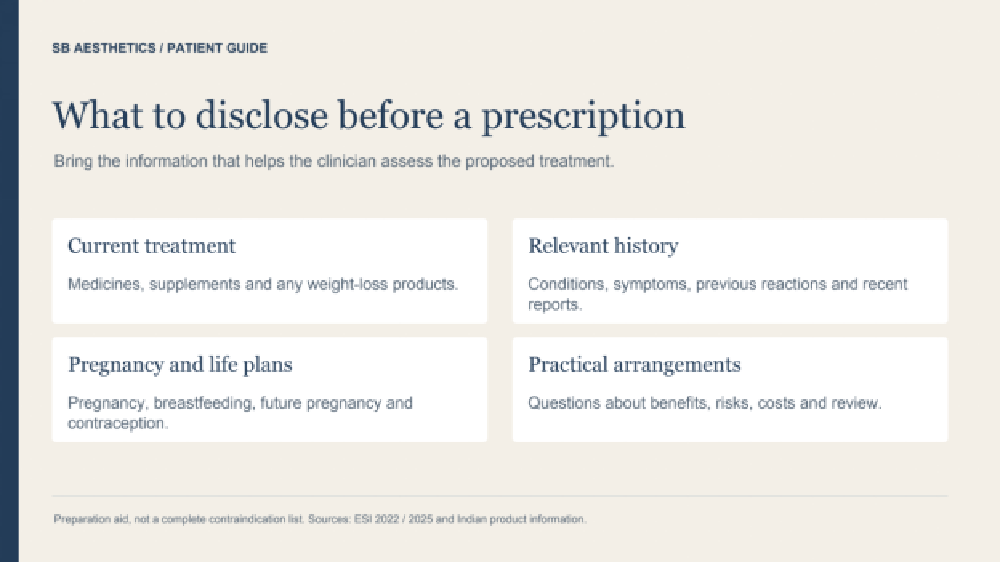
Bring a complete medicine list
Include prescribed medicines, over-the-counter products, supplements and any existing weight-loss treatment. If you are unsure of a name, photographs of the packaging can help the clinician identify it.
This matters for more than record-keeping. For example, the Indian prescribing information for Wegovy identifies an increased risk of low blood glucose when used with insulin or certain diabetes tablets. It also places limits on combining it with other semaglutide or GLP-1 medicines. These are reasons for a careful prescribing review, not instructions to alter an existing treatment yourself.
Tell the clinician about a previous reaction to a medicine, including which product you used and what happened. Do not leave a supplement out because it is sold as natural.
Health details that may change the plan
Some information needs discussion before a product is selected. The importance of each detail depends on the particular medicine and the person's health; a warning, a precaution and an absolute contraindication are different things.
Useful information to disclose includes:
- Previous pancreatitis, gallbladder problems or significant ongoing digestive symptoms.
- A personal or family history of medullary thyroid carcinoma (MTC), or a diagnosis of multiple endocrine neoplasia type 2 (MEN2).
- Kidney or liver disease and any relevant recent reports.
- Diabetes treatment, episodes of low blood glucose or known diabetes-related eye problems.
- Pregnancy, breastfeeding, plans for pregnancy and contraception.
- Previous serious medicine reactions and relevant personal or family medical history.
Be specific about the diagnosis rather than saying only “thyroid problems”. If a relative had thyroid cancer and you do not know its type, share that uncertainty and any available reports with the prescribing clinician.
This is a conversation aid, not a complete contraindication list. It cannot show that someone is suitable merely because none of the items seems to apply. The prescriber should check the full Indian information for the proposed product and explain which precautions matter to you.
Pregnancy planning deserves a clear discussion, rather than a brief yes-or-no question at the end. For example, Wegovy's Indian information says it should not be used during pregnancy or breastfeeding. Ask for product-specific advice about contraception and future pregnancy; do not work out a treatment or stopping schedule from an article.
If you are already using a weight-management medicine, ask what symptoms need prompt medical attention. Severe or persistent abdominal pain, or repeated vomiting that makes it difficult to keep fluids down, warrants medical assessment rather than waiting for a routine review.
What should you understand before agreeing to treatment
A medicine can be within its approved indication and still require a careful discussion about whether it is a sensible choice for an individual. Expected benefit, unwanted effects, alternatives and practical demands all belong in that decision.
The ESI's medication-counselling recommendations include benefits, limitations, adverse effects and cost, both before treatment and during it. A useful consultation makes those subjects specific enough to act on.
Ask what health concern the medicine is intended to address and how progress will be judged. Find out which side effects should prompt contact and who will provide that advice. Discuss the likely costs of consultations, investigations and ongoing care as well as the medicine itself. If attending reviews or paying for treatment could be difficult, explain that before the plan is agreed. For further background before that conversation, read Dr. Shilpi’s guide to Ozempic-type medicines in India: costs, safety and side effects.
Dietary, physical-activity and behavioural support also need to fit your circumstances. A shared family kitchen, shift work, travel or physical limitations are reasonable subjects to raise. The aim is to understand how a proposed plan would work in your actual week. If you also have questions about changes in appearance or body composition, read our explainer on what rapid weight loss can mean for the face, skin and muscle.
Questions to take to the prescribing appointment
You do not need to arrive with your own treatment decision. A short list can help you leave with a clearer one.
- What health problem are we trying to address, and why consider medication now?
- Which exact medicine are we discussing, and how does its Indian indication apply?
- Does anything in my history or current treatment change its suitability?
- What benefits, important risks and alternatives should I understand?
- What follow-up, costs and contact arrangements should we agree?
The answer may be a prescription, further assessment or a different approach. If medication is not advised, ask what the next useful step is. A decision against one treatment should still leave you with an explanation of the care being proposed.
Common questions about injection eligibility
These questions often arise after the first discussion. Each answer still needs to be applied to the exact medicine and individual person.
Does PCOS automatically mean I should use a weight-loss injection
No. PCOS is relevant medical history, but a diagnosis alone does not select a medicine or establish its weight-management indication. The clinician needs to consider the wider assessment and the proposed product.
Can an online BMI calculator tell me which injection to use
No. It can calculate a height-and-weight index. It cannot review your history, check interactions, interpret the full prescribing information or decide which treatment is appropriate.
What if I only want to lose a few kilograms before an event
Discuss your concern honestly, but a deadline is not a medical indication. Lilly India's information specifically states that Mounjaro is not approved for cosmetic weight loss. Prescription treatment requires an appropriate clinical reason and supervision.
Can I decide to stop or change treatment once I reach a target
Discuss changes with the prescribing clinician. A target on the scales does not supply the instructions for ending, switching or restarting a medicine. Agree how the treatment and longer-term plan will be reviewed.
The most useful outcome of an eligibility discussion is understanding the reasoning: what needs care, why a particular option is being considered and what happens next. That explanation should be available whether or not the appointment ends with a prescription.
Medically reviewed by Dr. Shilpi Bhadani
MBBS, MS (General Surgery), MCh (Plastic Surgery), MRCS(Edin)
Haryana Medical Council Reg. No. HN36204
Founder-Director & Chief Plastic Surgeon, SB Aesthetics & Plastic Surgery Hospital, Gurugram
Medical information disclaimer: This article is for general patient education and does not replace an individual consultation, physical examination or medical advice. Treatment eligibility, potential risks and monitoring needs vary from person to person.

Dr. Shilpi Bhadani
MBBS, MS - General Surgery, MCh - Plastic & Reconstructive Surgery,
DAFPRS Fellowship in Aesthetic Surgery


Request An Appointment
Recent Blog Posts
Am I Eligible for Weight-Loss Injections? BMI, Medical History and Other Factors Doctors Consider
November 17, 2026
How AI Is Changing Rhinoplasty Planning in 2026
November 16, 2026
Medical Weight Loss in Gurgaon: From Your First Assessment to Long-Term Weight Management
November 10, 2026
Grade 1, 2 and 3 Gynecomastia: Which Cases Need Surgery?
November 9, 2026
360° Liposuction: What Is It and Who Is a Good Candidate?
November 6, 2026

SB Aesthetics is one of the renowned medical centers in Gurgaon offering world-class and most advanced plastic surgeries procedures under the guidance of Dr. Shilpi Bhadani.
Request An Appointment
Last reviewed: June 2026
Medically reviewed by Dr. Shilpi Bhadani.
Copyright © 2021-2026, SB Aesthetics. All Rights Reserved. Powered by DigiLantern


