 +91 8130134693
 info@sbaestheticsclinic.com


 +91 8130134693
 info@sbaestheticsclinic.com
Bad Scars, Keloids and Scar Revision: What Can Actually Be Improved?
 By Dr. Shilpi Bhadani
 November 23, 2026
Two scars can look equally prominent and yet need very different treatments.
One may be raised, thick and itchy. Another may have become wide because the skin healed under tension. A third may pull so tightly across a joint that ordinary movement becomes uncomfortable.
Patients often describe all three as bad scars. But in plastic surgery, identifying why a scar looks or behaves the way it does is the first step towards treating it.
A scar cannot be completely erased. However, depending on its type, maturity, location and the surrounding skin, treatment may help flatten it, improve its texture, relieve discomfort, make it less noticeable or restore movement.
The important question is not simply, “Can this scar be removed?” It is, “What exactly needs to be improved, and which treatment offers a reasonable chance of achieving it?”
Why do some scars heal badly?
Whenever the skin is injured deeply enough, the body produces collagen to repair the damaged tissue. This is an essential part of healing, but scar tissue does not have exactly the same structure or properties as the original skin.
The final appearance depends on several factors: the depth of the injury, the part of the body affected, wound tension, inflammation, infection, individual healing tendencies and genetic predisposition.
A scar across the chest or shoulder may behave differently from one on the eyelid. A clean surgical incision may heal differently from an irregular wound caused by a road accident or burn.
Scarring also changes with time. A scar that looks red, firm or conspicuous in its early months may gradually soften and fade. Some scars continue to thicken or grow instead.
This is why treating a scar before understanding its behaviour can lead to disappointment.
What are the different types of problematic scars?
Hypertrophic scars
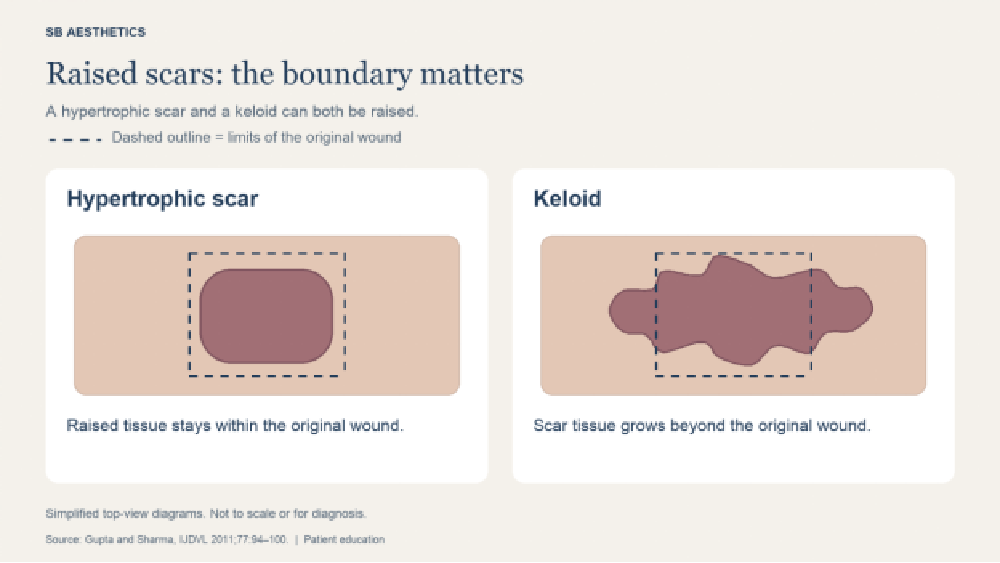
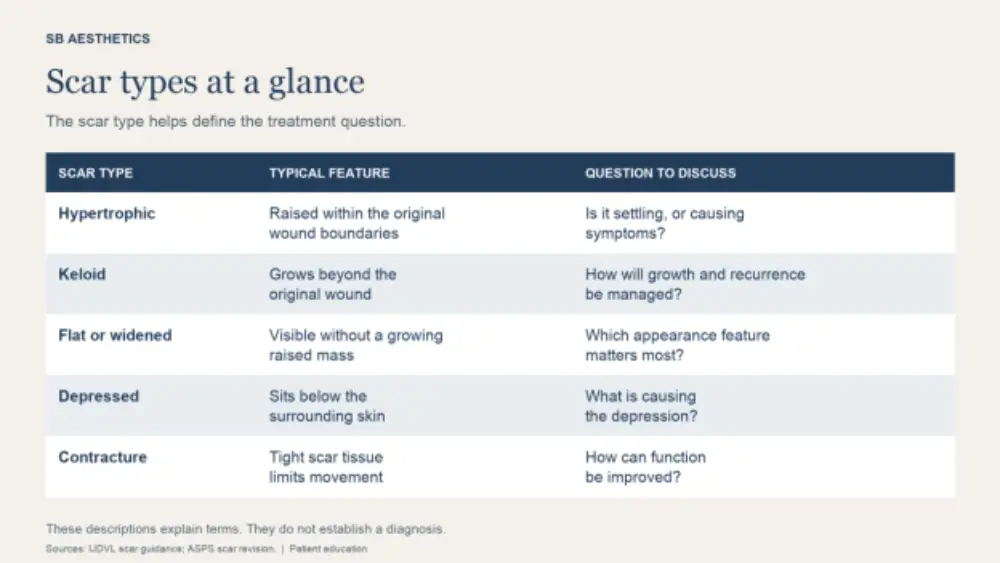
A hypertrophic scar is raised and often red or pink, but it remains within the boundaries of the original wound.
These scars may develop after surgery, burns or other injuries. They can feel thick, itchy or uncomfortable. Some gradually flatten as they mature, while others benefit from treatment.
Keloid scars
A keloid grows beyond the boundaries of the original injury.
It may develop after an operation, piercing, acne lesion, burn or relatively minor skin injury. Keloids can be firm, irregular, painful or persistently itchy, and they may continue enlarging after the original wound has healed.
A personal or family history of keloids is particularly relevant. People with darker skin tones also have a higher tendency to develop them.
Keloids require careful management because they can return after treatment, particularly following surgical removal without additional measures.
For a more detailed discussion of these scars, read our earlier article, Keloid Scars and Best Ways to Treat Them.
Wide or stretched scars
Some scars heal flat but become broader than expected.
This may happen when the wound has been exposed to considerable tension, has healed slowly or has widened during the healing process.
Unlike an actively growing keloid, a mature, stretched scar may sometimes be suitable for surgical revision. The surgeon must still consider whether the surrounding skin can be brought together with less tension than before.
Depressed or sunken scars
Other scars sit below the level of the surrounding skin.
These can develop after acne, injury or tissue loss. They require a different approach from raised scars because the problem may involve loss of tissue, tethering beneath the skin or an uneven surface.
Depending on the individual scar, treatment may involve resurfacing, surgical release, selected filling techniques or a combination of approaches.
Contracture scars
A contracture occurs when scar tissue tightens and restricts the movement of the surrounding skin or a joint.
These are particularly important after burns. A contracture near the neck, fingers, armpit or another mobile area can interfere with everyday activities.
Here, scar treatment is not merely cosmetic. Restoring flexibility and movement may be the main reason to consider reconstructive surgery.
Can bad scars be treated without surgery?
Yes. In fact, non-surgical treatment is often considered before an operation, especially for raised scars and keloids.
The right treatment depends on whether the scar is actively growing, how mature it is, its thickness and symptoms, and the patient's skin characteristics.
Silicone gels and sheets
Silicone-based treatments are frequently used for raised scars and may help reduce hardness, thickness and discomfort over time.
They are generally applied only after the wound has fully closed, not over an open wound or scab. Consistency is important, and results usually develop gradually.
Steroid injections
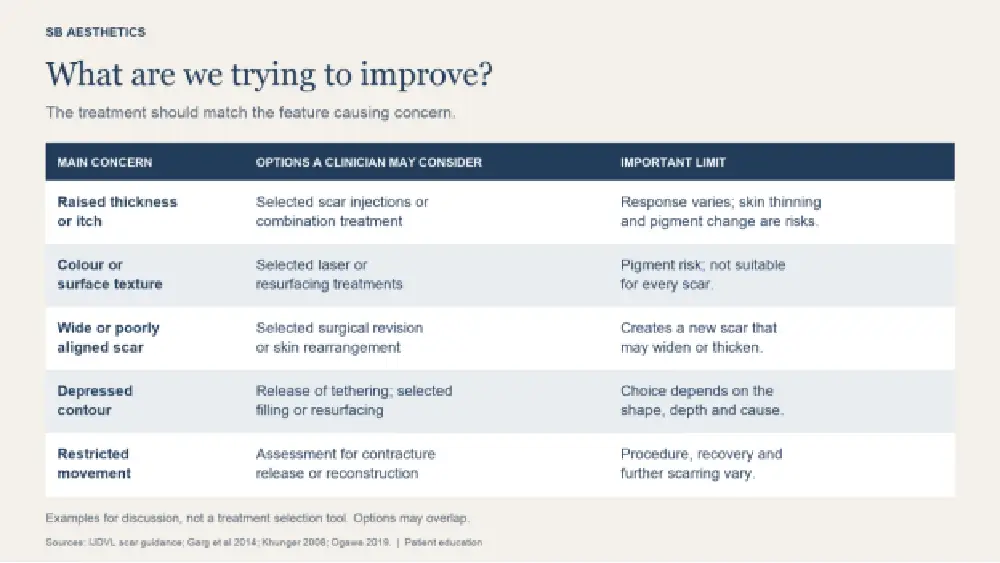
Corticosteroid injections are commonly used for hypertrophic scars and keloids. The medicine is injected directly into the scar to help reduce its thickness and associated symptoms such as itching.
Several sessions may be necessary. Possible side effects include skin thinning and pigment changes, so the treatment needs appropriate medical supervision.
Laser treatments
Different lasers address different scar characteristics.
Some can reduce redness, while others may improve thickness, surface irregularity or stiffness. Fractional laser treatments may be considered for selected mature scars.
Laser treatment is not appropriate for every scar. Skin pigmentation, scar depth, the risk of discolouration and the possibility of a worsening response all influence the decision.
Cryotherapy and other injections
Cryotherapy uses controlled freezing to reduce certain raised scars, especially smaller keloids. Other medications, including 5-fluorouracil, may be used by specialists in selected cases.
These approaches may be combined with other treatments rather than relied upon individually. Cryotherapy also carries a risk of lasting light patches, which requires particular consideration in darker skin.
For some scars, the best initial treatment is simply to allow further maturation while following appropriate scar-care advice.
When is scar revision surgery necessary?
Surgery becomes an option when a scar causes a problem that conservative treatment cannot adequately address, or when its shape and location make meaningful improvement surgically feasible.
A wide, mature scar may sometimes be removed and closed again using techniques intended to reduce tension and improve alignment. In other cases, the surgeon may rearrange local skin through procedures such as Z-plasty or W-plasty.
Contracture scars may require surgical release. Larger areas of damaged or deficient skin can sometimes require skin grafts or local tissue flaps.
These procedures differ considerably in complexity. The treatment plan depends on the amount of tissue involved, the location, blood supply, previous procedures and functional requirements.
Scar revision is not the same as scar removal.
An operation creates another wound, and that wound must heal into a new scar. The intention is to produce a better-positioned, less restrictive or less conspicuous scar than the original one.
There is always a possibility that the new scar will widen, thicken or heal unfavourably. Infection, wound-healing problems and the need for further treatment are additional considerations.
A particularly important caution concerns keloids. Removing a keloid surgically without controlling the underlying tendency to form excessive scar tissue carries a high risk of recurrence.
For selected patients, surgeons may therefore consider combined treatment involving injections, pressure therapy or, in carefully assessed cases, postoperative radiotherapy. Radiotherapy has its own risks and is not a routine solution for every patient.
The decision to operate should be based on whether the expected improvement justifies creating another wound.
Why are burn scars different from ordinary surgical scars?
Burn injuries can affect large, irregular areas of skin and sometimes involve deeper tissues. Their consequences may extend beyond the visible scar.
A burn scar can be raised or tight. The affected skin may also become unusually dark, lose pigmentation, develop a different texture or have reduced flexibility.
For a plastic surgeon, three separate questions arise:
- Appearance: Is the main concern colour, thickness or surface irregularity?
- Function: Is the scar restricting movement, stretching nearby structures or causing discomfort?
- Tissue quality: Is the skin healthy and flexible enough for the proposed treatment?
These questions become especially important when burns affect areas such as the breast, hands, neck or intimate regions, where scars may alter movement, growth or normal anatomical function.
Treatment may involve scar therapy, rehabilitation, lasers or reconstructive surgery. Pigmentation changes need their own assessment and cannot automatically be corrected by the same method used to flatten a raised scar.
We will explore dark burn scars, white patches after burns and reconstruction of scars in sensitive anatomical areas in separate articles in this series.
Should you treat a scar early or wait for it to mature?
Timing can substantially influence the treatment plan.
Many scars continue changing for a year or longer after an injury. A recently healed scar may still be undergoing active remodelling, while an older scar is more likely to have reached a relatively stable state.
For a scar that is improving, a surgeon may recommend observation, scar protection and non-surgical management before considering an elective revision.
However, waiting is not always the right answer.
A growing keloid, a persistently symptomatic raised scar or a contracture that limits movement deserves timely assessment. A scar that repeatedly breaks down, bleeds, develops discharge or changes unexpectedly should also be examined rather than assumed to be a routine healing problem.
The appropriate time for treatment is determined by the scar's behaviour, not simply by the number of months since the original injury.
How does a plastic surgeon decide which scar treatment is appropriate?
A good scar consultation begins with the history of the injury and how the scar has changed.
The surgeon will want to know how the wound occurred, when it healed, whether previous treatments were attempted and whether the patient has developed abnormal scars elsewhere.
The examination then considers the scar's height, colour, thickness, texture, mobility, location and relationship to the surrounding skin.
For a patient seeking scar revision in Gurgaon or Delhi NCR, it is useful to bring previous treatment records and photographs showing how the scar has changed, where available.
The goals of treatment also need to be clear. Reducing itching, restoring movement and improving a scar's appearance are related but different objectives. They may require different techniques and different measures of success.
At SB Aesthetics & Plastic Surgery Hospital in Gurugram, Dr. Shilpi Bhadani's background in plastic and reconstructive surgery provides the clinical context for assessing concerns involving abnormal scarring, tissue quality and surgical revision.
An informed treatment decision should explain what improvement is realistic, why a particular option is being considered, what its limitations are and whether further sessions or surgery might be required.
Sometimes an operation is appropriate. Sometimes treating the scar without surgery is preferable. And sometimes the most sensible recommendation is to wait.
Frequently Asked Questions About Bad Scars and Keloids
Can an old scar be improved after several years?
Yes, some mature scars can be improved through appropriate treatment. The available options depend on the type, depth, location and condition of the surrounding skin. Age alone does not determine whether scar revision is worthwhile.
What is the difference between a hypertrophic scar and a keloid?
A hypertrophic scar becomes raised but remains within the original wound boundaries. A keloid grows beyond them and has a greater tendency to persist or recur following treatment.
Can keloids return after surgery?
Yes. Keloid recurrence is an important concern, particularly when surgical removal is performed without additional treatment. A specialist may recommend a combined treatment plan and continued follow-up to reduce this risk.
Is laser treatment better than scar revision surgery?
Neither is universally better. Lasers may help selected scars with redness, thickness or texture concerns. Surgery may be more useful for particular wide scars, contractures or tissue deformities. Some patients need both.
Can scar revision surgery make a scar completely disappear?
No. Scar revision aims to improve appearance, comfort or function. Even when an existing scar is surgically removed, the new incision must heal and will leave a scar.
How much does scar revision or keloid treatment cost in Gurgaon?
The cost depends on the scar's size, location and complexity, along with the treatment required. Repeated injections or laser sessions involve different costs from surgical scar revision, grafting or reconstructive procedures. An individual assessment is needed before a meaningful estimate can be given.
When should I consult a plastic surgeon for a scar?
Consider an assessment if a scar is becoming thicker or larger, causes persistent itching or pain, restricts movement, repeatedly breaks down or remains a significant concern. Early evaluation is particularly useful when there is a history of keloid formation or a burn-related contracture.
A Better Scar Begins With the Right Diagnosis
The aim of scar management is not to promise flawless skin.
It is to understand how the injury healed, identify what remains treatable and select an intervention proportionate to the problem.
A scar that needs flattening should not automatically be excised. A scar that restricts movement should not be treated as a purely cosmetic concern. And a scar that is still improving may not need an intervention at all.
The most successful treatment plan begins with knowing what kind of scar you are treating — and what improvement is realistically possible.
Medically reviewed by Dr. Shilpi Bhadani
MBBS, MS (General Surgery), MCh (Plastic Surgery), MRCS(Edin)
Haryana Medical Council Reg. No. HN36204
Founder-Director & Chief Plastic Surgeon, SB Aesthetics & Plastic Surgery Hospital, Gurugram
Medical information disclaimer: This article is for general patient education and does not replace an individual consultation, physical examination or medical advice. Treatment suitability, risks and recovery vary between patients.

Dr. Shilpi Bhadani
MBBS, MS - General Surgery, MCh - Plastic & Reconstructive Surgery,
DAFPRS Fellowship in Aesthetic Surgery


Request An Appointment
Recent Blog Posts
Bad Scars, Keloids and Scar Revision: What Can Actually Be Improved?
November 23, 2026
Am I Eligible for Weight-Loss Injections? BMI, Medical History and Other Factors Doctors Consider
November 17, 2026
How AI Is Changing Rhinoplasty Planning in 2026
November 16, 2026
Medical Weight Loss in Gurgaon: From Your First Assessment to Long-Term Weight Management
November 10, 2026
Grade 1, 2 and 3 Gynecomastia: Which Cases Need Surgery?
November 9, 2026

SB Aesthetics is one of the renowned medical centers in Gurgaon offering world-class and most advanced plastic surgeries procedures under the guidance of Dr. Shilpi Bhadani.
Request An Appointment
Last reviewed: June 2026
Medically reviewed by Dr. Shilpi Bhadani.
Copyright © 2021-2026, SB Aesthetics. All Rights Reserved. Powered by DigiLantern


