 +91 8130134693
 info@sbaestheticsclinic.com


 +91 8130134693
 info@sbaestheticsclinic.com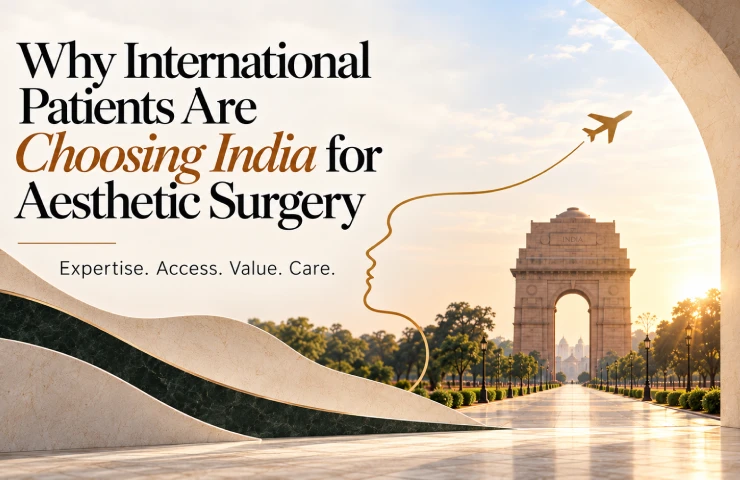
Why Choose India for Aesthetic Surgery? A Practical Guide for International Patients
 By Dr. Shilpi Bhadani
 October 1, 2026
India is becoming an increasingly attractive option for international patients considering aesthetic surgery, combining specialist care, accessible pricing, and a well-established medical-travel ecosystem
For an international patient considering aesthetic surgery abroad, India offers a combination that is difficult to ignore: deeply trained surgical specialists, a mature private healthcare sector, substantial cost advantages, major international transport links, and an established system for patients travelling specifically for medical treatment.
This is not an emerging idea waiting to be tested. More than half a million foreign nationals travelled to India specifically for medical treatment in 2025. The Government of India recorded 507,244 medical-purpose foreign arrivals that year, representing around 5.5% of all foreign tourist arrivals. Cosmetic surgery is specifically identified by the government among the treatments for which overseas patients travel to India.
For aesthetic-surgery patients in particular, India's appeal goes beyond affordability. The country's formal plastic-surgery training pathway can be highly demanding; major cities offer sophisticated private healthcare infrastructure; English is widely used in medical education and clinical practice; and specialist-led practices can offer a more individualised patient journey than patients sometimes expect when travelling abroad.
The result is an increasingly compelling proposition: access to experienced specialist surgeons and modern care at a cost that can make high-quality private aesthetic treatment considerably more accessible.
Why is India becoming such an important destination for medical travel?
India already has scale, infrastructure, and a substantial history of caring for patients from outside the country.
Government figures show hundreds of thousands of foreign patients entering India for medical purposes annually. In 2025 alone, the number was 507,244. India was also ranked 10th among 46 destinations in the Medical Tourism Index cited by the Government of India.
The country's medical-travel ecosystem has become sufficiently established that the Government of India operates a dedicated Heal in India initiative and an official Medical Value Travel platform designed to connect international patients with healthcare providers and information about treatment, visas, accommodation, and other parts of the journey.
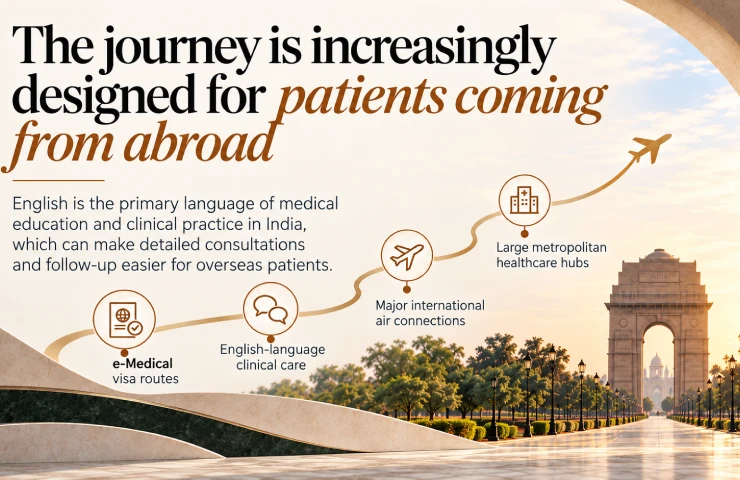
India also has specific e-Medical and e-Medical Attendant Visa categories. The live Government of India e-Visa portal allows eligible patients to apply electronically and permits up to two e-Medical Attendant Visas against one e-Medical Visa.
For someone considering elective surgery abroad, this matters. You are not travelling to a country where international healthcare is an afterthought. Medical travel is already a recognised part of India's healthcare and policy infrastructure.
What makes plastic-surgery training in India rigorous?
One of India's strongest advantages is often poorly understood outside the country: plastic surgery is a formal surgical super-specialty.
The National Medical Commission recognises M.Ch. in Plastic & Reconstructive Surgery as a super-specialty medical qualification. The current postgraduate framework lists prior surgical qualifications such as MS/DNB General Surgery among the feeder routes into M.Ch. Plastic & Reconstructive Surgery.
This means that one established pathway to becoming a specialist plastic surgeon in India involves medical school followed by postgraduate surgical training and then super-specialty training in plastic and reconstructive surgery. The National Board of Examinations in Medical Sciences also lists Plastic & Reconstructive Surgery as a DrNB super-specialty and offers a direct six-year DrNB pathway after MBBS.
The breadth of the training is equally important. The National Medical Commission's competency-based curriculum for M.Ch. Plastic & Reconstructive Surgery includes aesthetic surgery, reconstructive surgery, burns, microsurgery, hand surgery, craniofacial surgery, breast surgery, head and neck reconstruction, and other areas of the specialty.
That reconstructive foundation is particularly relevant to aesthetic surgery. A well-trained plastic surgeon is not learning only how to perform an isolated cosmetic technique. Their education is built around anatomy, tissue handling, wound healing, reconstruction, surgical complications, and the ability to make decisions when anatomy or circumstances differ from the ideal case.
Of course, not every person offering cosmetic procedures in India has the same training. International patients should therefore look specifically at the surgeon's qualifications rather than relying on labels such as “aesthetic expert” or “cosmetic doctor.”
Our guide on How to Find the Right Plastic Surgeon for Your Procedure explains what to verify when comparing surgeons, including qualifications, experience, communication, transparency, and the setting in which surgery will be performed.
Is aesthetic surgery in India really more affordable?
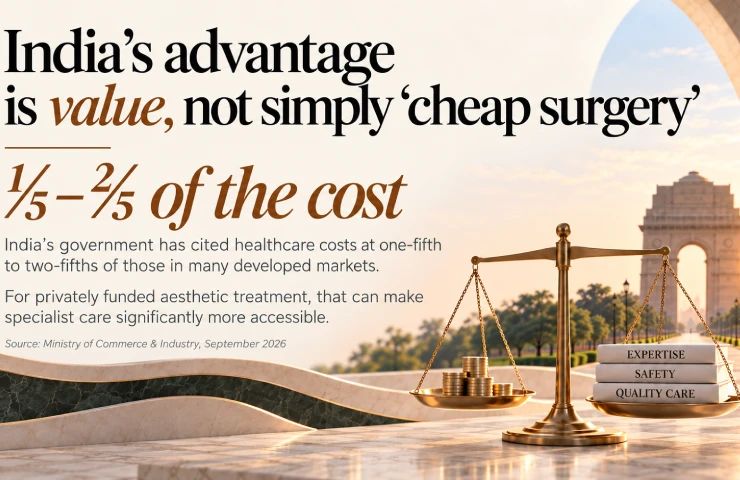
Yes, and for many international patients the difference can be substantial.
India's cost advantage is easier to understand in fractions than percentages. The Government of India has described medical care in India as available at around one-third or even one-quarter (60% to 80% less) of the cost of treatment in several developed countries. This is a broad healthcare comparison rather than a fixed price rule for every aesthetic procedure, but it helps explain why privately funded patients often find India financially attractive.
The lower cost also deserves an honest explanation. It does not come from one single factor. Healthcare in India operates within a lower-cost economic environment: staffing and human-resource expenses, support services, hospital operations, and several other inputs can cost less than in higher-income healthcare markets. Research on medical tourism identifies lower labour costs and wider operating-cost differences as important contributors to the price gap, while studies of Indian hospitals show that human resources are one of the largest components of hospital operating expenditure.
In other words, a lower quotation in India does not automatically mean that less has been spent on the surgeon's education or that the treatment itself must be of a lower standard. Much of the difference can come from the economics of delivering healthcare in India.
For an aesthetic-surgery patient, the sensible comparison is therefore not simply “Which country is cheaper?” It is whether the overall price still includes an appropriately trained surgeon, anaesthesia, a suitable surgical setting, investigations where required, postoperative reviews, and enough time for recovery.
Value is the advantage to look for, rather than the lowest possible price.
Does India offer easier communication for international patients?
Communication is one of the less obvious advantages of seeking treatment in India.
English is the principal language of medical education in India and is widely used in clinical practice, a point the Government of India itself highlights in its medical-tourism material.
This can make consultations, consent discussions, medical records, prescriptions, postoperative instructions, and communication with accompanying relatives considerably easier for many international patients.
In aesthetic surgery, where the surgeon needs to understand subtle preferences rather than simply diagnose a disease, this becomes particularly valuable. Words such as “natural,” “refined,” “subtle,” “proportionate,” or “too much” can mean different things to different people. Being able to have a detailed conversation directly with the surgeon can make the consultation more useful and reduce misunderstandings.
For patients considering SB Aesthetics, our detailed article Inside an Aesthetic Surgery Consultation: What Is Your Plastic Surgeon Really Assessing? explains what can be assessed remotely before travelling, what still needs to be examined in person, and how the final surgical plan is developed. During consultation, tools such as Crisalix 3D simulation may also help patients visualise possible changes and discuss proportions, expectations, and treatment goals more clearly with the surgeon.
Can international patients receive more personalised care in India?
The answer depends on the practice you choose, but this can be another important reason to consider India.
Large healthcare systems anywhere in the world can feel fragmented: one person conducts the consultation, another handles administration, a different team performs the procedure, and postoperative questions pass through several layers.
Specialist-led practices in India can offer a different experience, particularly when international-patient care has been deliberately organised around the surgeon and a dedicated team.
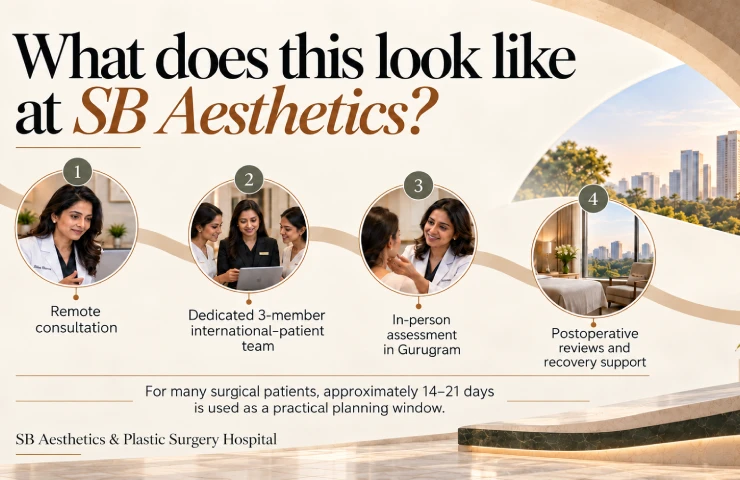
At SB Aesthetics, international enquiries are handled by reception and a dedicated three-member international-patient team. The pathway begins before the patient leaves home, with preliminary discussion, remote consultation, medical-history review, treatment planning, and practical coordination.
Once the patient arrives in Gurugram, the clinical relationship continues through the in-person consultation, preoperative assessment, surgery, postoperative reviews, and recovery. Depending on the operation and individual requirements, postoperative support at SB Aesthetics may also include dietetic guidance, physiotherapy, and RF massage where clinically appropriate.
This is where “personalised care” becomes something tangible rather than a marketing phrase. It means having enough time for examination, changing the proposed plan when necessary, providing postoperative review rather than rushing the patient onto a return flight, and maintaining a clear point of contact throughout the stay.
Why consider Delhi NCR and Gurugram for aesthetic surgery?
India has several major healthcare centres, and Delhi NCR offers a particularly practical combination for an international patient: a major international airport, extensive private healthcare infrastructure, diagnostics, specialist medical services, hotels, and serviced accommodation within one metropolitan region.
SB Aesthetics & Plastic Surgery Hospital is located in Sector 27, Gurugram, approximately 14–17 km by road from Delhi's Indira Gandhi International Airport, depending on the terminal and route. In normal traffic, patients should generally allow around 25–35 minutes by cab, although peak-hour congestion can make the journey longer.
For someone arriving after a long international flight, or attending postoperative reviews before travelling home, this proximity is useful. SB Aesthetics can also assist with arranging local pick-up and drop services and share nearby accommodation options across different budgets.
The practical advantage is simple: international patients can arrive through one of India's principal aviation hubs, stay close to the clinic during treatment and recovery, and avoid making long cross-city journeys for routine postoperative reviews.
Why consider SB Aesthetics and Dr Shilpi Bhadani?
India provides the broader advantages. The next decision is choosing the surgeon and practice through which you access them.
Dr Shilpi Bhadani's training follows the specialist surgical pathway international patients should look for. Her independently listed qualifications include MBBS, MS in General Surgery, and MCh in Plastic & Reconstructive Surgery, followed by a DAFPRS Fellowship in Aesthetic Surgery in Montreux, Switzerland. In addition, she also holds MRCS from the Royal College of Surgeons of Edinburgh, UK.
Her work at SB Aesthetics also extends beyond treating patients. The Indian Association of Aesthetic Plastic Surgeons lists Dr Shilpi as the mentor of an IAAPS-accredited aesthetic surgery fellowship centre in Gurugram, where fellows receive exposure to minor and major aesthetic procedures and academic training.
For an international patient comparing clinics online, this is an important signal. SB Aesthetics is not relying solely on lifestyle branding or before-and-after images to establish expertise; the practice sits within a continuing surgical training environment.
The clinic also works deliberately around the needs of patients coming from abroad. International patients can begin with a remote consultation, receive the appropriate hospital documentation once treatment planning is sufficiently clear, arrange travel with guidance from the clinic, undergo final assessment after arrival, remain locally for postoperative reviews, and obtain a Fit to Fly certificate before returning home.
For many surgical patients, SB Aesthetics recommends allowing roughly 14–21 days in India, although the appropriate period depends on the operation and individual recovery rather than a fixed package.
The intention is to make travelling for surgery feel organised rather than hurried.
How difficult is it to organise aesthetic surgery in India from overseas?
For eligible travellers, much of the preliminary process can now begin online.
India operates e-Medical Visa and e-Medical Attendant Visa categories through the Government of India's e-Visa system. The official portal allows e-Medical applicants to apply electronically and states that up to two e-Medical Attendant Visas can be issued for one patient.
At SB Aesthetics, the process normally begins before visa or flight arrangements are finalised. A remote consultation helps the team understand the proposed procedure, medical history, previous surgery where relevant, and likely timing. Once treatment and dates are sufficiently clear, SB Aesthetics can provide the relevant medical visa invitation or hospital documentation; the patient then submits the visa application directly through the appropriate Government of India system or Indian Mission.
The full practical process is covered separately in Medical Visa, Consultation, Surgery and Recovery: What to Prepare Before Coming to India. That guide explains visa preparation, travelling with medicines, insurance, accommodation, companions, preoperative assessment, recovery in Gurugram, and planning the return journey.
Keeping those logistical details in a dedicated guide allows the decision about India itself to remain focused on the larger question: whether the country offers the expertise, value, infrastructure, and care experience you are looking for.
Why choose India rather than simply having surgery closer to home?
For some patients, staying close to home will remain the right choice. For others, the advantages of India can be substantial enough to justify the journey.
India gives international patients access to formally trained plastic and reconstructive surgeons, large private healthcare networks, internationally benchmarked hospital accreditation systems, English-language medical care, established medical-travel infrastructure, dedicated medical visas, and treatment costs that can be significantly lower than those in developed healthcare markets. Government data showing more than half a million medical-purpose foreign arrivals in 2025 demonstrates that international patients are already making that calculation in significant numbers.
Aesthetic surgery adds another dimension because it is usually elective. You have time to research, compare surgeons, speak to the team remotely, understand your options, and travel only when you are comfortable with the decision.
For the right patient, India therefore offers something more compelling than “medical tourism.” It offers the possibility of accessing highly specialised private surgical care, with greater cost flexibility and a carefully planned patient experience, without treating expertise as a luxury available only in the world's most expensive healthcare markets.
Frequently Asked Questions
Why is India popular for plastic and cosmetic surgery?
India combines highly trained medical specialists, a large private healthcare sector, comparatively lower treatment costs, extensive medical infrastructure, widespread use of English in medicine, and a well-established international-patient ecosystem. Cosmetic surgery is among the specialties specifically identified in Government of India medical-tourism material.
Are plastic surgeons in India formally qualified?
India has recognised specialist qualifications specifically in Plastic & Reconstructive Surgery. The National Medical Commission recognises M.Ch. Plastic & Reconstructive Surgery as a super-specialty qualification, while the National Board of Examinations in Medical Sciences also offers DrNB training in Plastic & Reconstructive Surgery. Patients should verify the individual surgeon's qualifications because not everyone offering cosmetic procedures has undergone this specialist pathway.
Is aesthetic surgery in India less expensive than in the US, UK, or Europe?
It can be considerably less expensive. The Government of India has stated that medical treatment in India can cost around one-third or even one-quarter of the price in several developed countries. The exact difference for aesthetic surgery depends on the procedure, surgeon, facility, anaesthesia, investigations, implants where relevant, and postoperative care.
Part of India's cost advantage comes from lower staffing, facility, and broader operating costs compared with many higher-income healthcare markets. This is why international patients should compare the complete standard of care and what is included in the treatment plan, rather than assuming that a lower price necessarily means lower expertise.
Does lower cost mean lower-quality medical care?
Not necessarily. India's lower healthcare costs coexist with specialist medical training, large private hospitals, sophisticated medical technology, and internationally benchmarked accreditation systems. Quality still depends on the individual surgeon, facility, and treatment plan, so price should be considered alongside credentials and standards rather than used as the only selection criterion.
How do I find a properly trained plastic surgeon in India?
Look for recognised specialist qualifications such as MCh or DrNB in Plastic & Reconstructive Surgery, verify the surgeon's medical registration, examine procedure-specific experience, and understand where and how the operation will be performed. Our How to Find the Right Plastic Surgeon for Your Procedure guide provides a fuller checklist for comparing surgeons.
Can I speak to the surgeon before travelling?
Yes. At SB Aesthetics, international patients can begin with a remote consultation so that concerns, medical history, photographs, previous procedures, and possible treatment options can be discussed before travel. Final surgical planning follows an in-person assessment. Our article Inside an Aesthetic Surgery Consultation: What Is Your Plastic Surgeon Really Assessing? explains that process in detail.
Does India have a Medical Visa for cosmetic surgery patients?
India offers Medical and e-Medical Visa categories for eligible international patients, as well as e-Medical Attendant Visas. The official e-Visa system currently permits up to two e-Medical Attendant Visas for one e-Medical patient. Requirements vary by nationality and can change, so patients should always check the live Government of India portal before travelling.
How long should I stay in India for aesthetic surgery?
The answer depends on the procedure and recovery. At SB Aesthetics, approximately 14–21 days is used as a practical planning window for many international surgical patients, although minor procedures may require less time and major, combined, staged, or reconstructive operations may require longer.
Why choose Gurugram for plastic surgery?
Gurugram sits within Delhi NCR, with access to Delhi's international airport, major hospitals, diagnostic facilities, specialist medical services, hotels, serviced accommodation, and private transport. SB Aesthetics is located in Sector 27, Gurugram, and can assist international patients with local transport arrangements and nearby accommodation options.
What makes Dr Shilpi Bhadani relevant for international patients considering India?
Dr Shilpi Bhadani holds MBBS, MS General Surgery, MCh Plastic & Reconstructive Surgery, and MRCS from the Royal College of Surgeons of Edinburgh, UK, and completed aesthetic fellowship training in Switzerland. She is also listed by the Indian Association of Aesthetic Plastic Surgeons as the mentor of an IAAPS-accredited aesthetic surgery fellowship centre in Gurugram.
What should I do first if I am considering coming to India for surgery?
Begin with a remote consultation rather than booking surgery around fixed flights. This allows the surgeon to understand your goals and history and gives you a preliminary idea of treatment, timing, and what will need to be assessed after you arrive. Then read Medical Visa, Consultation, Surgery and Recovery: What to Prepare Before Coming to India before making your travel arrangements.
Considering aesthetic surgery in India?
India's appeal to international patients rests on a combination that few destinations can offer at the same scale: specialist surgical training, extensive private healthcare infrastructure, significant cost advantages, English-language medical care, established medical-travel systems, and access to surgeons whose practices are built around individualised treatment rather than high-volume packages.
At SB Aesthetics, the international-patient journey can begin remotely. The team can help you understand the proposed treatment, prepare for the in-person consultation, organise the appropriate hospital documentation for your medical visa application, plan your stay in Gurugram, and structure enough time for surgery and recovery before you travel home.
SB Aesthetics & Plastic Surgery Hospital
Plot No. NH1, Opposite Amiown Preschool
Sector 27, Gurugram 122002
Haryana, India
Medical review: Dr Shilpi Bhadani, MBBS, MS, MCh (Plastic & Reconstructive Surgery), Founder-Director & Chief Plastic Surgeon, SB Aesthetics.
This article is intended for patient education and does not replace individual medical assessment. Surgical candidacy, treatment planning, risks, recovery, and fitness to fly vary between patients. Visa and entry requirements can change; check current Government of India guidance before travelling.

Dr. Shilpi Bhadani
MBBS, MS - General Surgery, MCh - Plastic & Reconstructive Surgery,
DAFPRS Fellowship in Aesthetic Surgery


Request An Appointment
Recent Blog Posts
What Is Eyelid Surgery? Everything You Need to Know
August 24, 2026
Mini Facelift vs Full Facelift: Which One Is Right for You?
August 20, 2026
Rhinoplasty vs Septoplasty: Understanding the Difference
August 14, 2026

SB Aesthetics is one of the renowned medical centers in Gurgaon offering world-class and most advanced plastic surgeries procedures under the guidance of Dr. Shilpi Bhadani.
Request An Appointment
Last reviewed: June 2026
Medically reviewed by Dr. Shilpi Bhadani.
Copyright © 2021-2026, SB Aesthetics. All Rights Reserved. Powered by DigiLantern


