 +91 8130134693
 info@sbaestheticsclinic.com


 +91 8130134693
 info@sbaestheticsclinic.com
Medical Visa, Consultation, Surgery and Recovery: What to Prepare Before Coming to India
 By Dr. Shilpi Bhadani
 October 3, 2026
A practical starter kit for international patients considering plastic or aesthetic surgery at SB Aesthetics, Gurugram.
Travelling to India for plastic or aesthetic surgery is a significant decision, and it should feel carefully planned from the very beginning. Beyond choosing the right procedure and surgeon, patients also need to think about consultation, medical assessment, surgery, recovery, travel and support while they are away from home.
At SB Aesthetics, the focus is on safe surgical practice, thoughtful planning and helping patients move through this journey with clarity, comfort and confidence, while keeping both their aesthetic goals and quality of life in view.
This guide brings those pieces together for international patients considering treatment at SB Aesthetics & Plastic Surgery Hospital in Gurugram, India.
Planning principle: Do not book the shortest possible trip. Your visa, surgical plan, recovery period and fitness to fly are separate considerations.
Government and travel information last checked: 22 September 2026. Immigration and public-health requirements can change, so patients should recheck current Government of India guidance before travelling.
1. Before You Book Your Travel
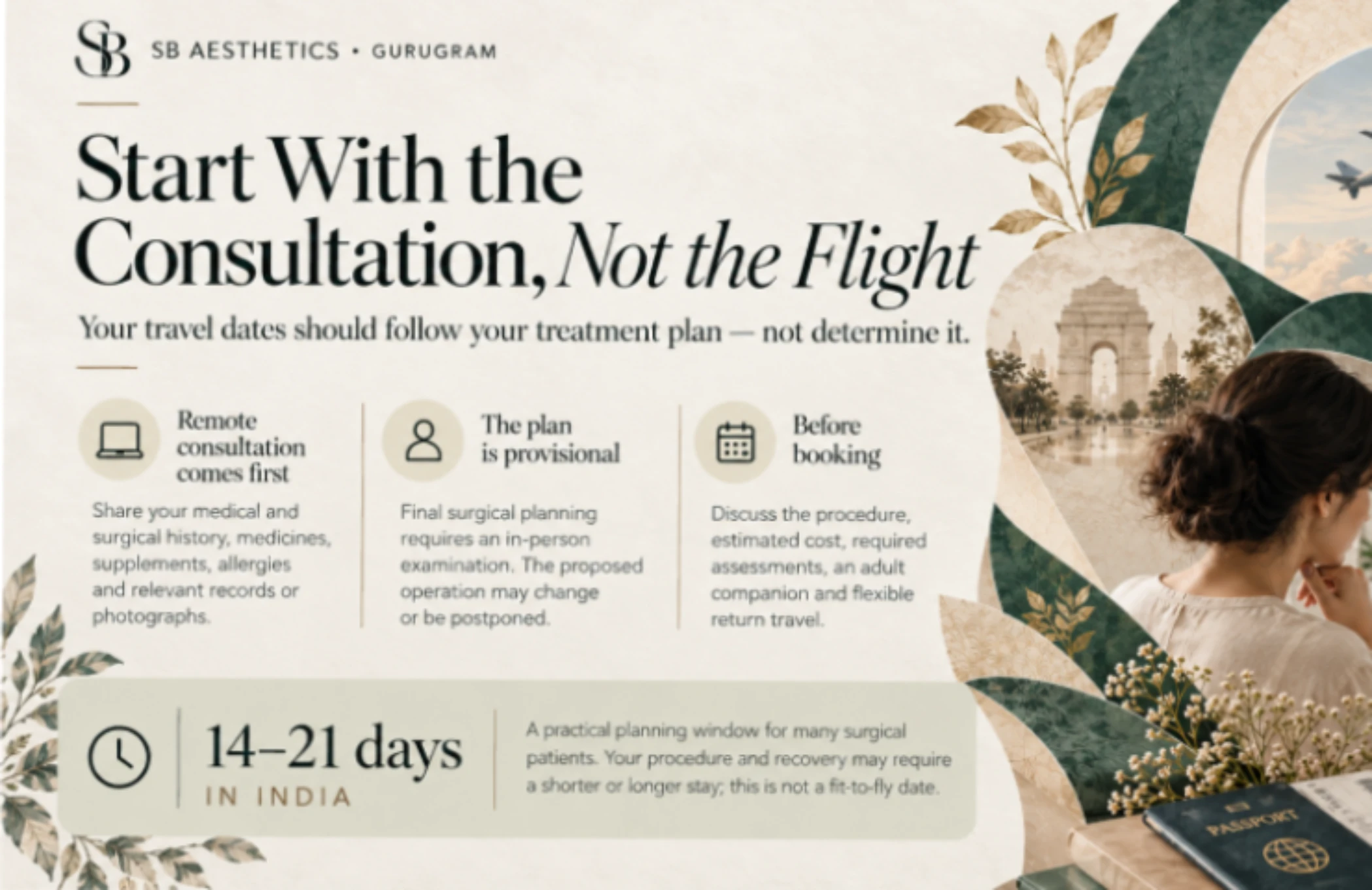
A good international surgical journey should begin with the clinical conversation, not the airline booking.
International-patient enquiries at SB Aesthetics are handled by reception and a dedicated three-member team that assists with consultations, procedure-related questions, preparation for the clinic visit and practical coordination around treatment.
For most international patients, the journey begins in stages: an initial conversation with SB Aesthetics, a remote consultation and preliminary discussion of the procedure, provisional treatment and travel planning, and a tentative financial discussion with the coordinator. Once the proposed treatment and dates are reasonably clear, we can provide the clinical or hospital documentation required for the applicable medical-visa process. The patient then completes the visa application directly through the Government of India or the relevant Indian Mission.
At this provisional stage, the coordinator will also discuss the estimated treatment cost, accepted payment methods and any booking advance required to reserve a proposed surgery date.
Depending on the procedure, the clinical team may ask for information such as your medical and surgical history, previous aesthetic procedures, current medicines and supplements, allergies, previous anaesthesia problems and relevant photographs or medical records.
If you have already had surgery in the area being discussed, previous operative records, implant details, imaging or treatment information may also be useful.
A remote consultation can be used to discuss your concerns, review relevant history and photographs, and prepare for the next stage of assessment. Final surgical planning requires an in-person examination.
The operative plan may change after your surgeon examines you directly, reviews investigations or identifies a medical or anatomical factor that was not apparent remotely. In some cases, the appropriate decision may be to modify the proposed operation, do less than originally planned or postpone surgery.
Before making non-refundable bookings, understand:
- which procedure is being considered;
- approximately how much time you may need in India;
- that an adult attendant or companion should travel with you;
- what information or investigations the clinical team needs from you;
- which Indian visa route applies to you; and
- whether your return journey can remain flexible if recovery takes longer than expected.
As a practical starting point, most international surgical patients should plan approximately 14–21 days in India. The appropriate stay depends on the procedure, recovery and whether any additional assessment or specialist clearance is required. Minor procedures may allow a shorter stay, while complex, staged or reconstructive treatment can require considerably longer.
2. Medical Visa and Entry Requirements
Which visa should I use if I am travelling to India for surgery?
If the purpose of your journey is planned medical treatment, check the Medical Visa or e-Medical Visa route applicable to your nationality and circumstances.
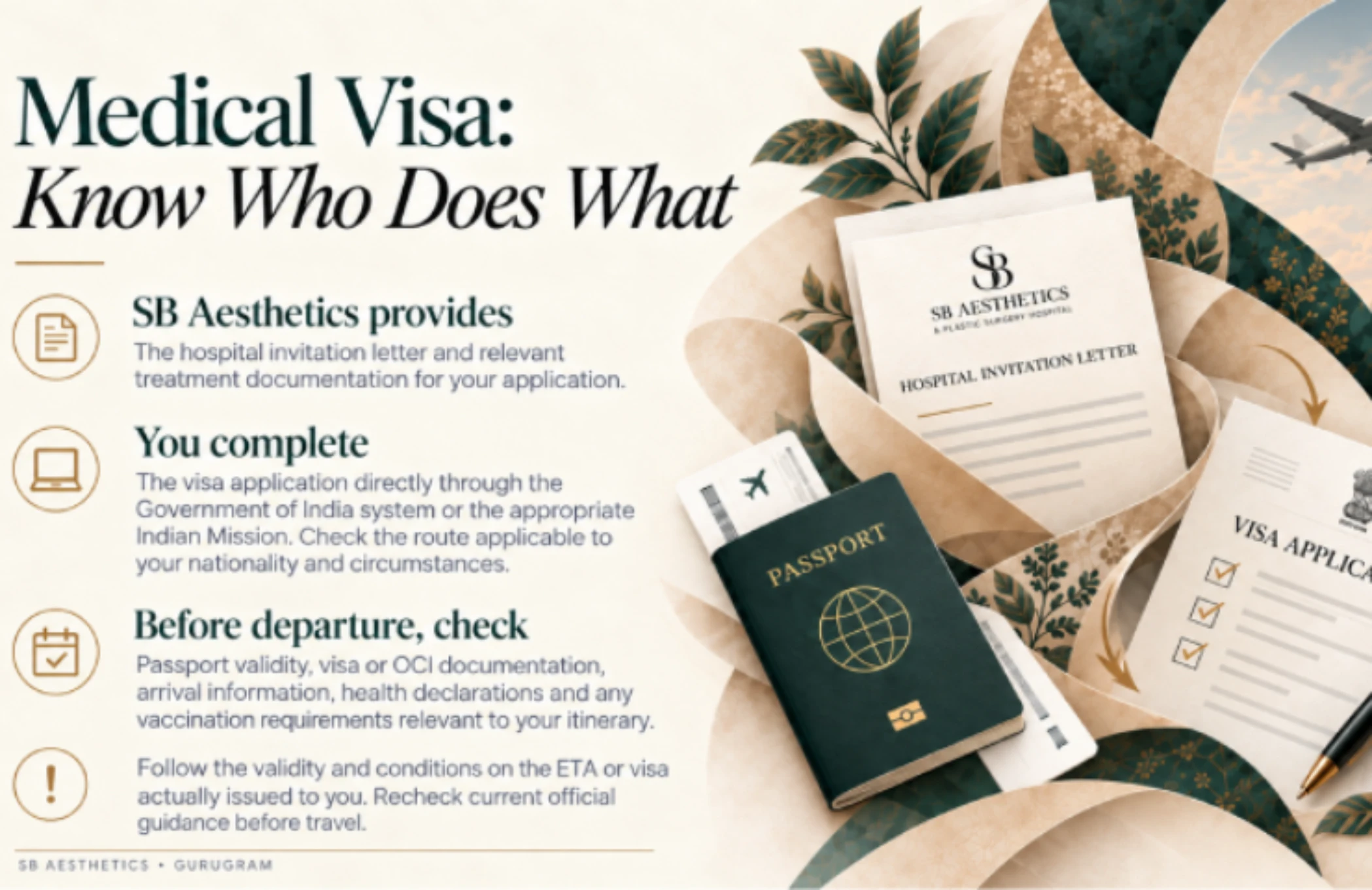
SB Aesthetics does not apply for or manage the visa on the patient’s behalf. However, the clinic is the point of contact for the hospital invitation letter and other treatment-related documentation required for the Medical Visa process. The patient then completes the visa application directly through the Government of India or the relevant Indian Embassy, High Commission or Consulate.
The Government of India's e-Visa system currently includes an e-Medical Visa for eligible passport holders. Applicants for e-Medical and e-Medical Attendant visas may currently apply at least four days before arrival, with an application window of up to 120 days before the proposed journey. The passport should generally have at least six months' validity at the time of application and at least two blank pages. Travellers should also have a return or onward ticket and sufficient funds for their stay.
The e-Medical application currently requires the passport bio page and a letter from the hospital concerned in India on hospital letterhead indicating the tentative date of admission or treatment.
How long is the e-Medical Visa valid?
There is an important point to check carefully.
As of 22 September 2026, the live Government of India e-Visa category table lists the e-Medical Visa and e-Medical Attendant Visa as valid for 365 days from arrival with multiple entries. However, an older FAQ still visible on the same official portal states a 60-day validity from first arrival.
Because the official portal currently contains conflicting information, rely on the validity, permitted stay and conditions shown on the ETA/e-Visa actually issued to you. If anything is unclear, obtain clarification from the Bureau of Immigration or the relevant Indian Mission before booking travel around it.
Can someone accompany me?
The current e-Visa rules allow up to two e-Medical Attendant Visas for one e-Medical Visa patient.
For international patients travelling to SB Aesthetics for surgery, we ask that you travel with an adult attendant or companion. Having someone with you is particularly important around admission, discharge, transport and the first part of recovery.
e-Arrival Card
Foreign nationals and OCI/eOCI cardholders can currently complete the e-Arrival Card within 72 hours before arrival in India. The card records arrival information; it is not a visa and does not replace your visa or OCI documentation.
Air Suvidha 2.0
India's current entry portal also directs international passengers to complete the Air Suvidha health Self-Declaration before arrival at immigration. Air Suvidha 2.0 was introduced in June 2026 as part of enhanced health surveillance at India's international points of entry.
The Ministry of Civil Aviation has warned travellers about fraudulent Air Suvidha websites. The official service is free, and passengers should not pay a third party to submit the form.
Because public-health measures can change quickly, check the current Government of India arrival guidance shortly before departure even if you have visited India recently.
Special entry and travel requirements that may apply to you
Not every traveller follows the same pathway.
Regular Medical Visa: Some travellers are not eligible for the e-Visa route and must apply through the appropriate Indian Mission. Follow the current instructions issued for your nationality and place of residence.
OCI cardholders: OCI holders generally travel using valid OCI status rather than obtaining a Medical Visa, but current arrival-information requirements still apply.
FRRO registration: FRRO registration: Under India’s current Immigration and Foreigners Rules, registration is generally not required where the visa permits a stay of 180 days or less and the traveller leaves within that period, unless the visa specifically requires registration. If treatment or recovery means remaining in India beyond 180 days, check the applicable e-FRRO registration requirements and the conditions on the visa issued to you.
Yellow fever: Travellers whose journey falls within India's yellow-fever requirements must carry a valid original vaccination certificate. The certificate becomes valid 10 days after vaccination and remains valid for life. A missing or defective certificate can lead to quarantine requirements.
Polio: India maintains vaccination requirements for travellers connected with countries currently designated for poliovirus transmission. The official list can change, so check the latest Ministry of Health guidance for your itinerary rather than relying on an old country list.
3. What to Prepare Before Coming to India

Your medical information
Before surgery abroad, make sure the clinical team knows about relevant medical conditions, previous operations, regular medication, supplements, allergies, anaesthesia problems and previous blood clots or clotting disorders.
Do not stop prescription medicines simply because you are preparing for surgery. This applies particularly to anticoagulants, diabetes medication, weight-management or GLP-1 medicines, hormonal medication and other long-term treatments. Any change should be made under appropriate medical guidance.
For patients with significant health conditions or complex medication, discussing the planned journey with the doctor who already knows your health history can also be useful. The CDC's 2026 travel guidance recommends pre-travel medical assessment where appropriate and advises planning this sufficiently in advance.
Bringing prescription medicines into India
Keep regular medicines in their original labelled packaging and carry the supporting prescription or medical letter where appropriate.
Indian drug rules permit small quantities of medicines to be imported in bona-fide passenger baggage for the traveller's own use. Rule 36 generally limits any single drug brought under this provision to 100 average doses unless exceptional permission is obtained.
Controlled, narcotic, psychotropic or otherwise restricted medication can be subject to additional rules. If you use such medication, or need to travel with an unusually large quantity, check the relevant Indian requirements before departure.
Insurance
Make sure you have international health insurance for your stay in India, and confirm with your insurer in advance whether planned plastic or aesthetic surgery, postoperative complications and any related medical care are covered under your policy. Coverage varies between insurers, so it is important to understand any exclusions before you travel.
Before travelling, ask your insurer specifically about elective surgery overseas and obtain clarity on cover for emergency treatment, postoperative complications, trip extension, changes to flights, hospital admission and medical evacuation or repatriation.
International Society of Aesthetic Plastic Surgery guidance similarly advises patients to establish what their personal health insurance will cover when surgery is performed in another country.
Accommodation and a companion
Choose accommodation for recovery and access to the clinic, rather than treating the trip as an ordinary holiday.
Consider travel time to SB Aesthetics, elevator access, comfortable sleeping arrangements, food and drinking water, transport for postoperative reviews and whether a companion can stay with you.
Choose accommodation that gives you enough flexibility for your in-person consultation, surgery, early recovery and postoperative reviews, with the option to extend your stay if your treating team advises it.
For some procedures, a week will not be enough.
4. Arriving in Gurugram and Visiting SB Aesthetics
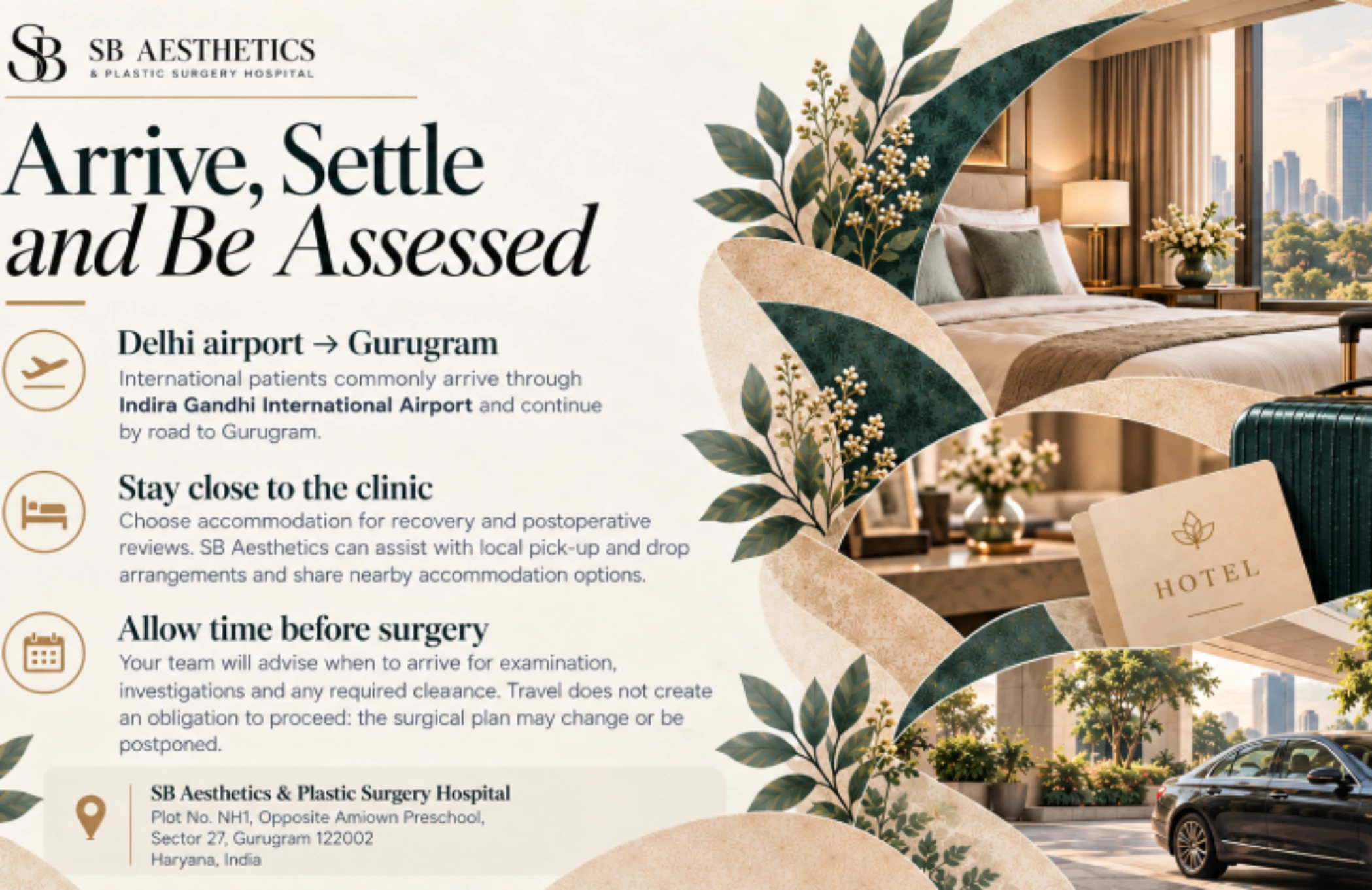
International patients travelling by air commonly arrive through Indira Gandhi International Airport in Delhi, which is one of India's authorised e-Visa arrival airports.
Getting to SB Aesthetics and staying nearby: The journey can be kept relatively simple: arrive through Delhi's Indira Gandhi International Airport, travel by road to Gurugram and stay close to the clinic during the treatment period. SB Aesthetics can assist with arranging local pick-up and drop services and can share a selection of nearby hotels and short-stay accommodation options across different budgets. Ride-hailing and private cab services are also readily available in Gurugram. As in any major city, normal travel precautions remain sensible.
SB Aesthetics is located in Gurugram within Delhi NCR:
SB Aesthetics & Plastic Surgery Hospital
Plot No. NH1
Opposite Amiown Preschool
Sector 27
Gurugram 122002
Haryana, India
SB Aesthetics & Plastic Surgery Hospital is open Monday to Sunday, 8:30 AM to 7:00 PM. International patients can contact the clinic at +91 81301 34693 or +91 93154 72650.
Avoid assuming that you can land after a long international journey and proceed directly to surgery.
Long-distance travel can mean prolonged sitting, disrupted sleep, fatigue and dehydration. More importantly, the final surgical decision requires an in-person clinical assessment.
Your treating team will advise when to arrive in relation to your planned procedure.
Our aim is to make the practical side of the journey predictable so that your attention can remain on the consultation, treatment and recovery.
5. Consultation and Preparing for Surgery
The in-person consultation is where preliminary plans become a clinical decision.
Your surgeon can examine your anatomy directly, understand your goals, review your health information and decide whether the proposed procedure is appropriate.
Before proceeding, you should understand:
- what operation is being proposed and why;
- reasonable alternatives;
- what the procedure can and cannot change;
- where scars may be placed where relevant;
- significant risks and possible complications;
- the expected early recovery;
- whether drains, dressings or compression garments may be needed;
- how long you should remain locally;
- when normal activities can gradually resume; and
- what follow-up will be needed after you leave India.
Investigations and anaesthesia assessment, where required, should be determined from your procedure, medical history and individual risk rather than a generic internet checklist.
The final plan should also leave room for a surgeon to say that an operation should be altered or postponed. International travel does not create an obligation to proceed with surgery if the clinical assessment indicates otherwise.
6. Recovery in India
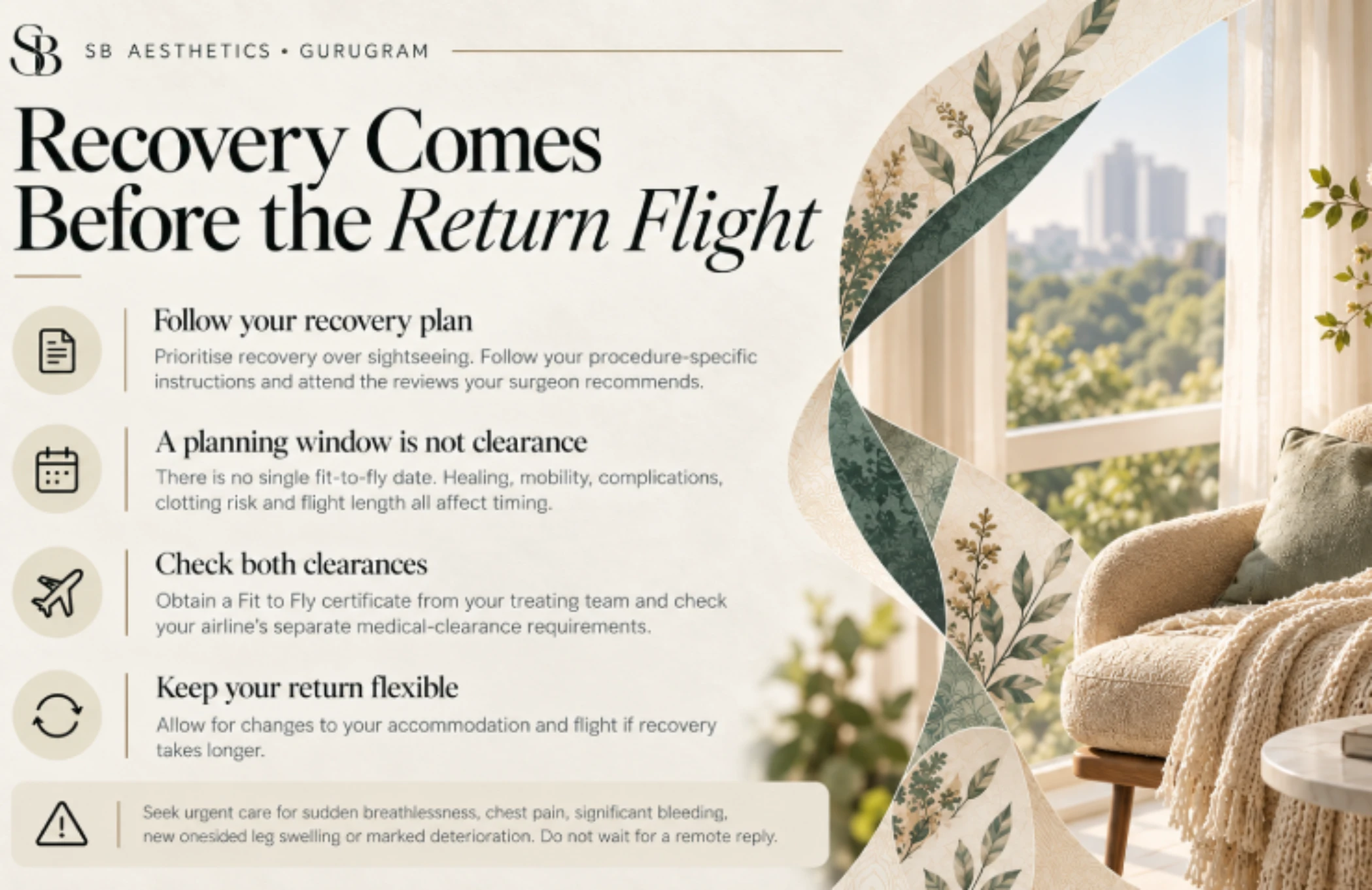
The first part of your stay after surgery should be treated as a recovery period.
Swelling, bruising, tightness, fatigue, discomfort and temporary limitations can occur after many plastic-surgery procedures, although the pattern and duration vary widely.
Follow the postoperative instructions given specifically for your operation regarding medicines, wound care, showering, dressings, drains, compression garments, sleeping position, walking, diet, activity and review appointments.
At SB Aesthetics, postoperative recovery is actively supported beyond the immediate surgical follow-up. Depending on the procedure and individual recovery, our care plan may include dietetic guidance, physiotherapy and RF massage where clinically appropriate. The treating team explains what is recommended, when it should begin and how it fits into the patient’s recovery timeline.
Avoid building a sightseeing programme into the early postoperative period. CDC medical-tourism guidance warns that activities such as alcohol consumption, strenuous exercise, sunbathing, swimming and lengthy tours can interfere with postoperative healing.
International patients should remain close enough to attend the reviews their surgeon considers necessary.
When should I seek urgent care?
Complications can occur after surgery anywhere.
Seek urgent medical assessment for serious new symptoms such as sudden breathlessness, chest pain, fainting or marked deterioration, significant or persistent bleeding, new one-sided leg swelling, rapidly worsening pain or another acute medical problem.
If you are still in India, contact the treating team and use emergency medical services when necessary.
If you are already back in your home country, seek appropriate local emergency care immediately rather than waiting for a reply from another country or time zone.
7. When Can You Fly Home After Plastic Surgery?
There is no single number of days after plastic surgery when every patient is safe to fly.
For trip planning, the broader 14–21-day window gives many international surgical patients a more realistic buffer for early reviews and recovery. It should not be interpreted as an automatic fit-to-fly date; your surgeon's assessment and the airline's requirements still determine when you can travel.
Surgery and prolonged travel can independently increase the risk of venous thromboembolism, including deep-vein thrombosis and pulmonary embolism. Sitting for a long period during travel can add to this risk during the postoperative period.
The type and extent of surgery, duration of anaesthesia, mobility, wound healing, swelling, complications, personal clotting risk, length of the flight and whether several procedures were combined can all affect travel timing.
CDC's 2026 Yellow Book advises avoiding air travel for 10 days after chest or abdominal surgery. It also cites American Society of Plastic Surgeons guidance recommending a 7–10-day interval after certain cosmetic procedures involving the face, eyelids or nose.
These are general reference points, not automatic clearance dates.
A patient undergoing an abdominal procedure may need longer than 10 days. A patient undergoing rhinoplasty may need longer than the commonly cited 7–10-day interval. Your surgeon's assessment of your recovery takes priority.
The airline also has its own rules
Clinical fitness to travel and permission to board an aircraft are separate issues.
Airlines can impose their own requirements following recent surgery, including medical certificates or formal medical-clearance procedures.
For example, Air India's current guidance does not permit travel within 10 days of major abdominal surgery and requires medical clearance after that point. Other conditions have their own restrictions.
Your airline may have different rules.
Before your return journey, obtain a Fit to Fly certificate from the treating team at SB Aesthetics. This confirms your clinical readiness to travel at that stage of recovery; your airline may still have its own medical-clearance requirements, so these should also be checked before departure.
A flexible return booking can therefore be much more practical than planning your operation around the shortest possible stay.
8. International Patient Checklist and FAQs
Before leaving home
Make sure you have completed the current visa and entry process applicable to you; checked your passport validity; completed the e-Arrival Card and any current health declaration; checked yellow-fever or polio requirements if relevant; packed important medicines in original labelled packaging; brought relevant medical information; arranged recovery-friendly accommodation; considered whether you need a companion; reviewed insurance coverage; and allowed sufficient flexibility in your return travel.
What should I carry with me?
Keep your passport, visa/ETA or OCI documentation, arrival confirmations, vaccination certificates where applicable, prescriptions, important medical records, insurance information and clinic contact details accessible during travel rather than placing every important document in checked baggage.
Frequently asked questions
How does SB Aesthetics support my Medical Visa application?
SB Aesthetics will issue the medical visa invitation letter and the relevant treatment documentation required for your application. You can then use these documents to apply for the Medical Visa through the Indian Embassy, High Commission or Consulate responsible for your place of residence. The visa application itself is completed by the patient directly with the relevant Indian Mission or Government of India system.
How early should I apply for an Indian e-Medical Visa?
Eligible applicants can currently apply up to 120 days before the proposed journey and must apply at least four days before arrival. Applying earlier than the minimum gives more time to resolve documentation issues.
How long is an Indian e-Medical Visa valid?
The current live category table says 365 days from arrival with multiple entries, while an older FAQ on the same government portal still says 60 days. Follow the validity and conditions actually printed on the ETA/e-Visa issued to you and seek official clarification if they are unclear.
Can a family member travel with me?
Yes. The current e-Medical Visa framework allows up to two e-Medical Attendant Visas for one patient. For the visa invitation letter, please share the full name and passport number exactly as they appear on the passport for the patient and each accompanying attendant. SB Aesthetics will include the relevant details in the invitation documentation required for the visa application.
Do I need an e-Arrival Card?
Under the current Government of India system, foreign nationals and OCI/eOCI holders can complete the e-Arrival Card within 72 hours before arrival.
Is Air Suvidha required at the moment?
As of 22 September 2026, India's official visa portal directs international passengers to complete the current Air Suvidha Self-Declaration. The service is free. Because the requirement is linked to public-health surveillance, recheck it immediately before travelling.
Do I need yellow-fever or polio vaccination?
Not every traveller does. The requirement depends on your journey and the countries covered by India's current public-health rules. Check the latest Ministry of Health guidance rather than relying on an old country list.
Can I bring my prescription medicines to India?
Small quantities of medicines for personal use can generally be carried under India's drug rules, subject to conditions and restrictions. Keep medicines properly labelled with appropriate supporting documentation and check separately if you use controlled medication.
Should I book my flight before my consultation?
It is better to discuss preliminary suitability and timing with the clinic before making inflexible travel arrangements. Final surgical candidacy still depends on appropriate clinical assessment.
How early should I arrive before surgery?
Please allow enough time before surgery for your in-person consultation, pre-operative assessment and any additional investigations or specialist clearance that may be required. Your treating team will advise the appropriate arrival window based on your procedure and medical history.
Do I need any additional medical clearance before surgery?
Sometimes. At SB Aesthetics, patients above 40 years of age undergoing a major or prolonged surgery are required to have a pre-operative cardiac evaluation. If the assessment identifies a concern, further investigations or specialist clearance may be advised before surgery.
Should I travel to India alone for plastic surgery?
If you are travelling to SB Aesthetics for surgery, plan to travel with an adult attendant or companion. They can assist with transport, discharge and practical support during the early recovery period.
How long should I stay in India after plastic surgery?
As a practical planning window, most international surgical patients should allow around 14–21 days in India. Some minor procedures may require less time, while major, combined, staged or reconstructive surgery can require longer. Your final travel date depends on how you are recovering and whether your surgeon considers you ready to fly.
When can I fly after rhinoplasty or facial surgery?
Published guidance gives 7–10 days as a general reference after certain facial, eyelid and nasal cosmetic procedures, but this is not an automatic fit-to-fly date. Your actual recovery and your airline's requirements must be considered.
When can I fly after abdominal plastic surgery?
CDC guidance advises avoiding flight for 10 days after abdominal surgery, but some patients will need longer. Operations such as abdominoplasty must be considered alongside mobility, healing, DVT risk, other procedures performed and the duration of the journey home.
Can I go sightseeing during recovery?
Not during the period when your surgeon has advised rest and restricted activity. Early recovery should take priority over tourism.
What if my recovery takes longer than expected?
Surgical recovery cannot be guaranteed to follow an exact travel itinerary. Allow reasonable flexibility in accommodation and your return journey, and follow clinical advice rather than an original booking date.
Contact SB Aesthetics
International-patient enquiries are handled by reception and a dedicated three-member team that assists patients with consultation, procedure-related questions, preparation for their clinic visit and practical coordination around treatment.
SB Aesthetics & Plastic Surgery Hospital
Plot No. NH1
Opposite Amiown Preschool
Sector 27
Gurugram 122002
Haryana, India
Phone: +91 81301 34693 / +91 93154 72650
Email: [email protected]
Medical and regulatory note
This guide is intended for education and practical preparation. It does not replace an individual medical assessment or official immigration advice.
Government entry requirements can change. Always check the Government of India's current visa, immigration and public-health instructions before travel.
Surgical candidacy, investigations, procedure selection, recovery and fitness to fly vary from patient to patient.
Government and travel information last verified: 2nd October 2026.
Link to the Kit

Dr. Shilpi Bhadani
MBBS, MS - General Surgery, MCh - Plastic & Reconstructive Surgery,
DAFPRS Fellowship in Aesthetic Surgery


Request An Appointment
Recent Blog Posts
Medical Visa, Consultation, Surgery and Recovery: What to Prepare Before Coming to India
October 3, 2026
What Is Eyelid Surgery? Everything You Need to Know
August 24, 2026
Mini Facelift vs Full Facelift: Which One Is Right for You?
August 20, 2026
Rhinoplasty vs Septoplasty: Understanding the Difference
August 14, 2026

SB Aesthetics is one of the renowned medical centers in Gurgaon offering world-class and most advanced plastic surgeries procedures under the guidance of Dr. Shilpi Bhadani.
Request An Appointment
Last reviewed: June 2026
Medically reviewed by Dr. Shilpi Bhadani.
Copyright © 2021-2026, SB Aesthetics. All Rights Reserved. Powered by DigiLantern


