 +91 8130134693
 info@sbaestheticsclinic.com


 +91 8130134693
 info@sbaestheticsclinic.com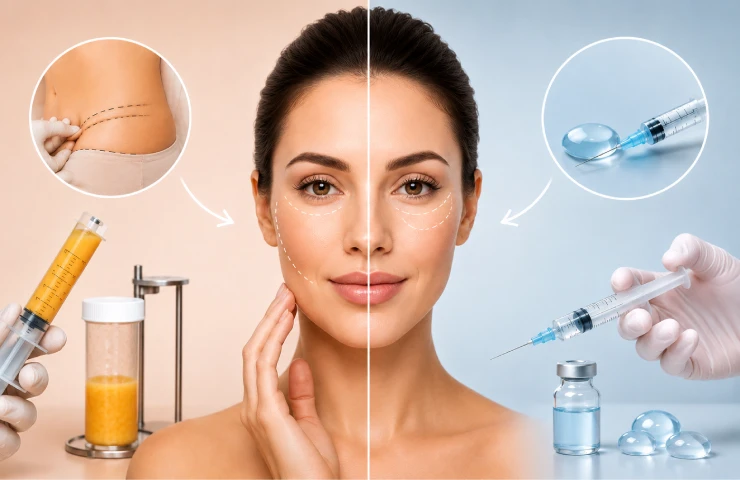
Fat Transfer vs. Fillers: Which One Is Right for You?
 By Dr. Shilpi Bhadani
 June 19, 2026
Fillers is one of the most popular aesthetic treatments for enhancing cheeks, lips, and jawlines. However, in recent times, many patients are exploring fat transfer as a long-lasting option. People want natural-looking rejuvenation without changing their facial features completely. Hence, the discussion around fat transfer vs fillers has become prevalent and important.
The reality is, both treatments deliver excellent results when done correctly, but they work differently for different concerns.
What is Fat Transfer?
Fat transfer, also known as fat grafting, is a procedure where fat is extracted from one area of the body, generally the thighs or abdomen, and then transferred to the facial areas that have lost volume. Unlike fillers, fat transfer uses the patient’s own tissue. The treatment is commonly used for:
- hollow cheeks,
- under-eye hollowness,
- temples,
- facial thinning,
- and age-related volume loss.
Benefits of Fat Transfer
- Uses the patient’s own body fat for a more natural approach
- Longer-lasting facial rejuvenation
- Softer and more naturally blended results
- Can improve age-related facial hollowness effectively
- Dual benefit of facial rejuvenation and body contouring
- Less risk of looking overfilled when performed correctly
Fat transfer requires surgical expertise and an expert understanding of facial balance. The outcome depends on the surgeon’s technique and careful handling. This is one of many reasons why patients consult Dr. Shilpi Bhadani at SB Aesthetics and Plastic Surgery Hospital for facial fat transfer procedures, because of the finesse she possesses when it comes to aesthetic treatments.
What are Fillers?
Fillers or dermal fillers are injectable treatments used for restoring lost volume and enhancing facial contours. People prefer this treatment because it is quick and minimally invasive. For many new patients, fillers come as the best option because they provide immediate changes without surgery or long healing periods. Fillers are commonly used for:
- Lip enhancement
- Cheek definition
- Jawline contouring
- Under-eye hollowness
- Smile lines
- Facial balancing
Benefits of Fillers
- Quick procedure with minimal downtime
- Immediate visible improvement
- Highly customizable and precise
- Ideal for first-time aesthetic patients
- Can be adjusted gradually over time
- Certain fillers are reversible if needed
A proficient surgeon’s primary goal is treatment planning that is focused on creating natural-looking facial harmony rather than simply adding volume.
Fat Transfer vs. Fillers: What’s the Real Difference?
Both of the treatments work to solve the same problem, that is, facial volume loss, but the mechanisms behind them are completely different.
Fillers are temporary and customizable volume enhancements, and are suitable for people who want quick results, flexibility, and minimal downtime.
On the other hand, Fat Transfer is a long-term tissue restoration. Since living fat cells from one's own body are integrated into the face, the restoration feels softer and more natural upon recovery.
In simpler terms, fillers are about convenience and precision, whereas fat transfer is about long-lasting rejuvenation.
- Results- Fat transfer provides long-lasting and often permanent results, as the transferred fat cells become a natural part of the face. Maintenance sessions are fewer compared to dermal fillers. Fillers are temporary and require repeated treatments.
- Recovery- Fat transfer is more invasive than dermal fillers as it involves surgery, anaesthesia, incisions, and may involve a longer recovery period. Fillers are minimally invasive with no downtime, allowing patients to resume their routine immediately.
Neither treatment is universally better. The right choice depends entirely on:
- Facial anatomy
- Skin quality
- Age-related volume loss
- Lifestyle
- Aesthetic goals
- Surgeon’s evaluation
And this is where consultation becomes extremely important.
Which One is Right For You - Fillers or Fat Transfer?
Both treatments restore facial volume and balance, but which treatment to go with is where most of the patients feel confused. This totally depends on what exactly is required by the patient. Fillers may be more appropriate if a patient wants:
- Subtle enhancement
- Minimal downtime
- Quick visible improvement
Fat transfer may be more suitable if:
- The patient’s facial volume loss is significant
- Patient wants long-lasting rejuvenation
- Patients prefer natural tissue over synthetic filler material
In some cases, patients may even benefit from combining different treatments strategically rather than choosing only one approach, because the goal is to restore balance that feels natural.
Why Choosing the Right Surgeon Matters
Aesthetic treatments and their approach differ from person to person, as facial rejuvenation is not just about adding volume; it is about maintaining facial balance and natural-looking results.
At SB Aesthetics and Plastic Surgery Hospital, Dr. Shilpi Bhadani focuses on customisable treatment planning based on the patient’s goals. With expertise in both surgical and non-surgical facial rejuvenation procedures, she guides patients toward treatments that support long-term facial harmony rather than temporary beauty trends.
Patients prefer results that are subtle, refreshed, and natural instead of obviously cosmetic. And honestly, in modern aesthetics, that subtlety matters more than ever.
Conclusion
The point of the discussion is not to determine whether fat transfer or fillers are superior. It is to understand what kind of rejuvenation is suitable for one’s face and expectations. Some patients prefer the convenience and flexibility of fillers, while others prioritise natural outcomes and longevity of fat transfer.
But in both cases, the quality of the outcome depends on proper consultation, individualised planning, and choosing a surgeon who understands facial rejuvenation beyond trends. At SB Aesthetics and Plastic Surgery Hospital in Gurgaon, the emphasis is always on helping patients look refreshed and confident while still looking like themselves.
Frequently Asked Questions (FAQs)
How do I know whether I need fillers or fat transfer?
It depends on factors like facial anatomy, volume loss, skin quality, and goals. To determine the best, a professional consultation is important.
Is fillers or fat transfer safer?
Both fillers and fat transfer are considered safe when performed by a qualified surgeon. Fillers are minimally invasive and involve little downtime, while fat transfer uses the patient’s own tissue, which reduces the risk of allergic reactions
Are fillers painful?
Most treatments of fillers involve minimal discomfort, as numbing techniques are used before the procedure.
Why are people moving away from fillers?
People want to look like a better version of themselves, healthier and fresher. Fillers add volume, but don’t actually improve the quality of the skin.
What is the best age for fat transfer?
Fat transfer is ideal for everyone, and adults from all age groups may benefit from fat transfer therapies.
Does fat transfer make you look younger?
Fat transfer not only revitalises the face but also refines body proportions for a more balanced and youthful appearance.

Dr. Shilpi Bhadani
MBBS, MS - General Surgery, MCh - Plastic & Reconstructive Surgery,
DAFPRS Fellowship in Aesthetic Surgery


Request An Appointment
Recent Blog Posts
What Is Eyelid Surgery? Everything You Need to Know
August 24, 2026
Mini Facelift vs Full Facelift: Which One Is Right for You?
August 20, 2026
Rhinoplasty vs Septoplasty: Understanding the Difference
August 14, 2026

SB Aesthetics is one of the renowned medical centers in Gurgaon offering world-class and most advanced plastic surgeries procedures under the guidance of Dr. Shilpi Bhadani.
Request An Appointment
Last reviewed: June 2026
Medically reviewed by Dr. Shilpi Bhadani.
Copyright © 2021-2026, SB Aesthetics. All Rights Reserved. Powered by DigiLantern


