 +91 8130134693
 info@sbaestheticsclinic.com


 +91 8130134693
 info@sbaestheticsclinic.com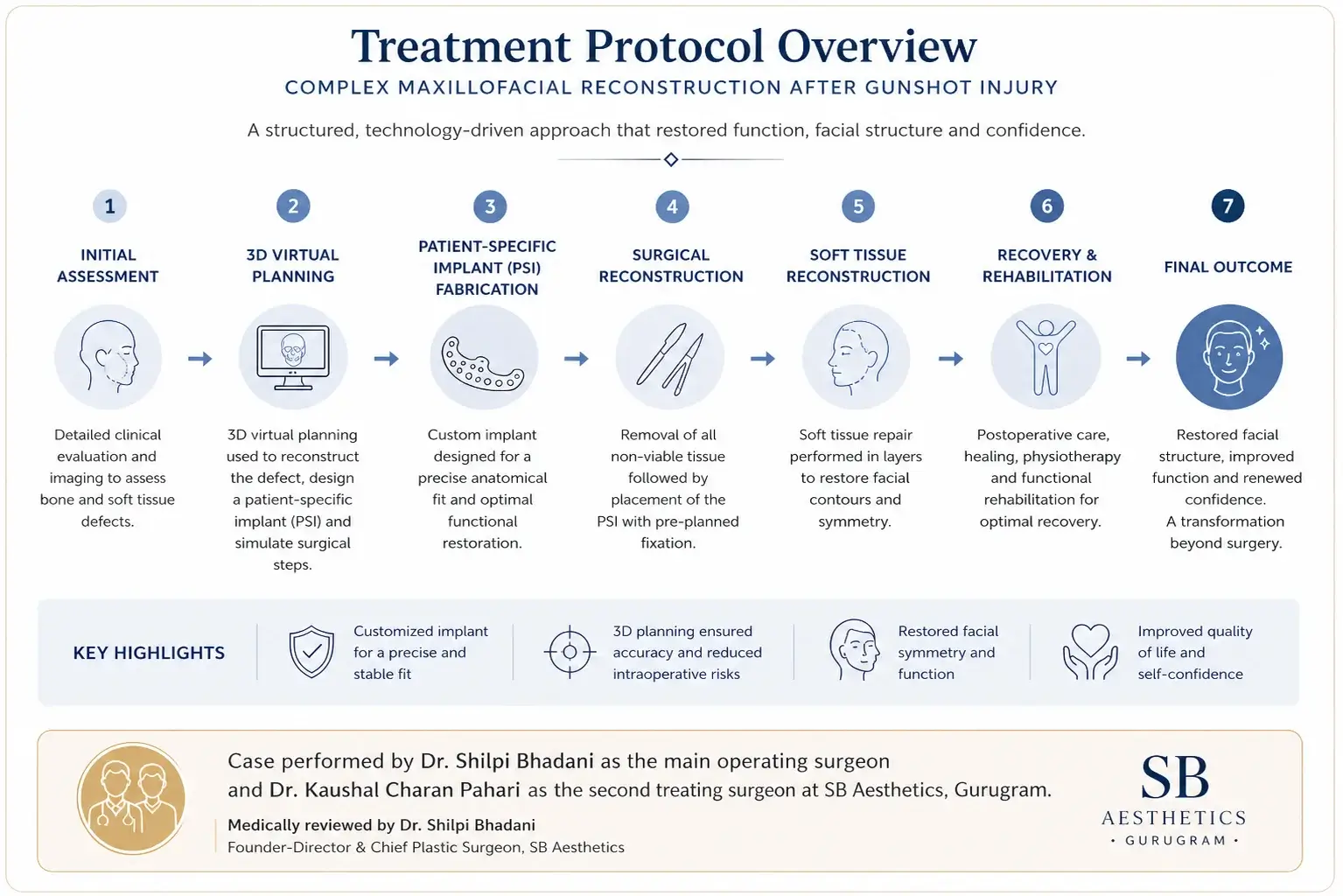
Complex Maxillofacial Reconstruction After Gunshot Injury: A 5-Year Follow-Up Case Study
 Medically reviewed by Dr. Shilpi Bhadani
 - Authored by Dr. Kaushal Charan Pahari
 Updated: April 28, 2026
This case study explains how a severe gunshot injury with complex maxillofacial tissue loss was reconstructed at SB Aesthetics. The patient was operated on by Dr. Shilpi Bhadani, Founder-Director & Chief Plastic Surgeon at SB Aesthetics, as the lead operating surgeon, with Dr. Kaushal Charan Pahari, BDS, MDS Maxillofacial Surgery, as the co-treating surgeon.
This case documents the reconstructive planning, maxillofacial considerations, intraoperative challenges, functional rehabilitation, and 5-year follow-up. The reconstruction involved digital planning, a patient-specific implant, soft tissue reconstruction, and functional rehabilitation with a fixed obturator.
Case overview
- Operating surgeons: Dr. Shilpi Bhadani, MBBS, MS, MCh (Plastic Surgery), Dr. Kaushal Charan Pahari, BDS, MDS Maxillofacial Surgery
- Case type: Complex maxillofacial reconstruction after trauma
- Technique used: Patient-specific implant (PSI) reconstruction, RAFF flap coverage, fixed obturator rehabilitation.
Patient presentation
The patient presented with a severe gunshot injury to the maxillofacial region, with extensive hard and soft tissue loss. The injury involved segmental maxillary and midfacial bone loss, significant soft tissue destruction, oro-nasal communication, functional compromise affecting speech and swallowing, and considerable psychological trauma related to facial disfigurement.
Clinical challenges
This was not a routine reconstructive problem. The case involved multiple layers of difficulty:
- loss of maxillary and midfacial bony support
- major soft tissue compromise
- distorted or missing surgical landmarks
- functional issues involving speech and swallowing
- the need to restore both structure and dignity in a single long-term plan
Treatment planning
The reconstructive plan included:
- patient-specific implant (PSI)-based reconstruction for skeletal framework restoration
- RAFF-based soft tissue reconstruction for coverage
- fixed obturator prosthesis for functional restoration
Preoperative planning used 3D virtual planning to digitally reconstruct the defect, design a patient-specific implant tailored to the remaining anatomy, simulate surgical steps, and pre-plan fixation points and implant positioning. This improved predictability, but as with all major reconstructive trauma surgery, planning could not fully eliminate intraoperative uncertainty.
Procedure performed
At SB Aesthetics, the case was operated on by Dr. Shilpi Bhadani as the lead operating surgeon, with Dr. Kaushal Charan Pahari as co-treating surgeon. The surgical objective was to restore skeletal support, achieve reliable soft tissue coverage, and rebuild functional capacity with prosthetic rehabilitation. The surgical objective was to restore skeletal support, achieve reliable soft tissue coverage, and rebuild functional capacity with prosthetic rehabilitation
Intraoperative considerations
Despite detailed planning, several challenges emerged during surgery.
Altered anatomy
Gunshot injuries do not follow clean or predictable lines. In this case, bone fragmentation and soft tissue destruction made orientation difficult, and usual anatomical landmarks were either absent or significantly distorted.
Soft tissue constraints
Closure over a rigid patient-specific implant was especially demanding because the available soft tissue was compromised. The reconstruction required careful attention to vascularity, contour, and functional integration.
PSI adaptation and fixation
Even with a customized implant, intraoperative adaptation remained technically challenging because of minor fit discrepancies, tissue interference, and limited access for screw placement.
Functional rehabilitation
The fixed obturator had to align precisely with the reconstructed framework. This step was important not only for structural support, but also for speech, swallowing, and patient confidence.
Intraoperative decision-making
This case also highlights an important principle in complex reconstruction: planning provides the roadmap, but surgical judgment shapes the outcome on the table.
During surgery, the team made real-time adjustments including:
- minor modifications in PSI positioning
- dynamic adaptation of soft tissue handling
- changes in flap design to improve coverage and vascularity
Recovery and follow-up
The long-term follow-up is one of the strongest aspects of this case. At 5 years postoperatively, the patient was thankful, had returned to daily routine, and was able to manage day-to-day life with restored function.
Outcome
The case was successfully managed with:
- stable skeletal reconstruction
- adequate soft tissue coverage
- functional restoration using a fixed obturator
- an acceptable aesthetic outcome
What this case highlights
This case demonstrates several principles that matter in complex facial reconstruction:
No case is routine
Even with experience, uncommon trauma patterns introduce new surgical variables.
Planning matters, but flexibility matters more
3D planning and patient-specific implants can improve predictability, but they do not remove uncertainty.
Reconstruction is about more than bone
Speech, swallowing, facial contour, and patient confidence all matter in treatment planning.
Experience supports better judgment
In complex surgery, outcome depends not only on technique, but on the ability to adapt responsibly in real time.
Expert note from SB Aesthetics
At SB Aesthetics, complex cases are approached through structured planning, individualized decision-making, and multidisciplinary support. Cases like this reflect the importance of combining technical reconstruction with functional rehabilitation and long-term follow-up. Results vary by anatomy, injury severity, tissue condition, and recovery factors.
You can also explore our real patient results to understand how outcomes vary by concern, anatomy, and procedure. If you would like a personalized evaluation for a reconstructive or facial concern, you can book an appointment with the SB Aesthetics team.
Frequently asked questions
What is maxillofacial reconstruction after trauma?
Maxillofacial reconstruction is the process of restoring facial structure and function after major injury, tumor loss, or congenital problems. Depending on the defect, treatment may involve bone reconstruction, soft tissue coverage, prosthetic support, and long-term rehabilitation for speech, swallowing, and facial balance.
What is a patient-specific implant in facial reconstruction?
A patient-specific implant, or PSI, is a custom implant designed from imaging and digital planning to fit the patient’s anatomy as precisely as possible. In complex defects, PSI-based planning can improve surgical accuracy, though intraoperative adjustments may still be required.
Why can facial gunshot injuries be especially difficult to reconstruct?
These injuries often create irregular bone loss, severe soft tissue damage, and distorted landmarks. That makes both planning and execution more demanding. The reconstructive goal is not only to close the defect, but to restore function, facial support, and long-term quality of life.
Can speech and swallowing improve after complex maxillary reconstruction?
They can improve when the reconstruction restores structural support and when prosthetic rehabilitation, such as an obturator, is properly integrated. The degree of recovery depends on the extent of injury, tissue condition, and the overall treatment plan.
Why does long-term follow-up matter in reconstructive cases?
Long-term follow-up helps assess not just healing, but function, prosthetic stability, comfort, adaptation, and the durability of the reconstruction. A short-term result may look satisfactory, but meaningful recovery is best judged over time.
Why patients choose SB Aesthetics
SB Aesthetics combines specialist surgical care with medically reviewed patient education, multidisciplinary support, and a trust-first approach. The clinic’s credibility signals include structured educational content, a listed team of doctors, and verified public profile details for Dr. Shilpi Bhadani across major platforms.
Medical review and disclaimer
Medically reviewed by Dr. Shilpi Bhadani, Founder-Director & Chief Plastic Surgeon, SB Aesthetics. This case study is intended for education and awareness and should not replace an in-person medical evaluation. Treatment decisions should always be individualized.
Request An Appointment
SB Aesthetics
SB Aesthetics & Plastic Surgery Hospital,
Plot No NH 1,
Opposite Amiown Preschool,
Sector 27,
Gurugram 122002
Haryana
Mail ID: info@sbaestheticsclinic.com
Clinic hours: Monday – Sunday 8:30 AM – 7:00 PM

SB Aesthetics is one of the renowned medical centers in Gurgaon offering world-class and most advanced plastic surgeries procedures under the guidance of Dr. Shilpi Bhadani.
Request An Appointment
Last reviewed: June 2026
Medically reviewed by Dr. Shilpi Bhadani.
Copyright © 2021-2026, SB Aesthetics. All Rights Reserved. Powered by DigiLantern


